
How to Improve English Writing Skills for Beginners: 9 Practical Tips
Writing in English can feel difficult when you are a beginner. You know what you want to say in your native language, but when you try to write it in English, the sentences don't come out right. Many learners give up because they think good writing needs perfect grammar or a big vocabulary.
In reality, good writing is a skill you build step by step, just like riding a bicycle. In this guide, you will learn 9 practical tips to improve your English writing skills, simple daily exercises, useful tools and the mistakes beginners should avoid.
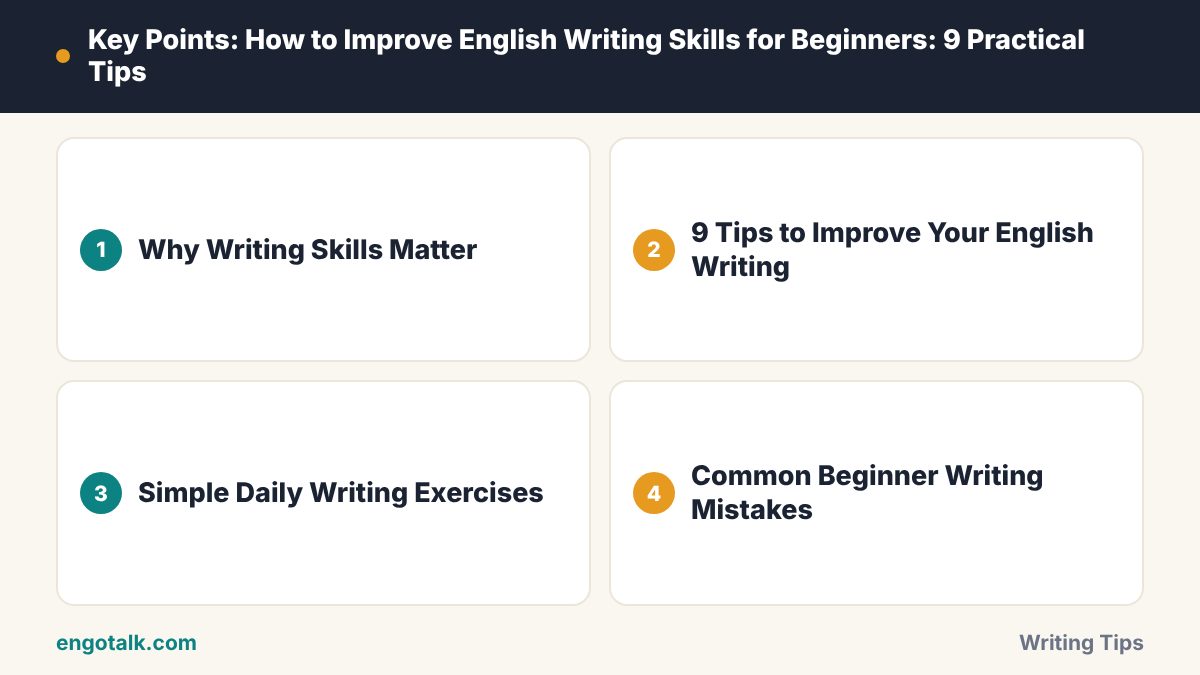
Why Writing Skills Matter
Study: Exams, assignments and IELTS all require written English.
Work: Emails, reports and job applications are usually in English.
Confidence: Writing helps you organise your thoughts, which also improves your speaking.
9 Tips to Improve Your English Writing
1. Write a little every day
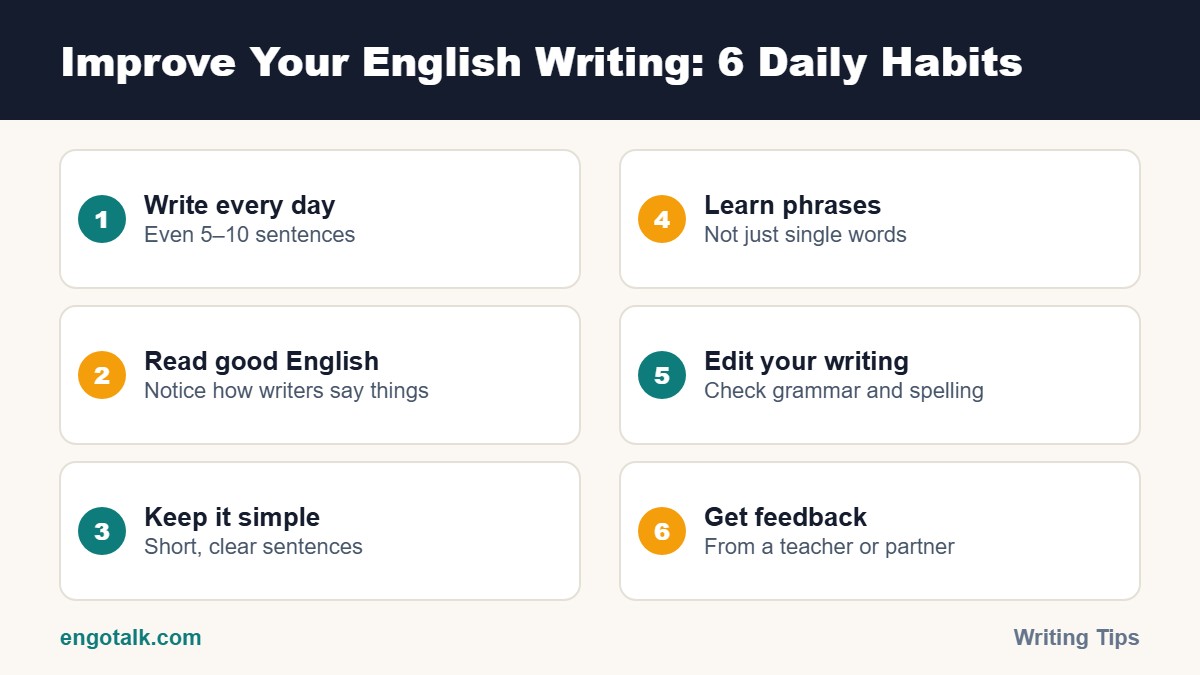
Consistency matters more than length. Write 5–10 sentences a day about your day, your plans or something you learned. After a month, you will see clear progress.
2. Start with simple sentences
Beginners often try to write long, complicated sentences and make many mistakes. Clear, short sentences are better. "I went to the market. I bought vegetables." is perfectly good English.
3. Read more to write better
Reading shows you how good writers build sentences and paragraphs. Read short articles, stories and blogs at your level. Our 20-minute reading method is a great start.
4. Learn phrases, not just words
Instead of memorising "decision", learn "make a decision". Phrases help you write naturally and avoid strange word combinations. Here's how to build vocabulary through reading.
5. Learn basic paragraph structure
Every good paragraph has a topic sentence, supporting sentences and a conclusion. Learn this simple structure in our guide on how to write a paragraph in English.
6. Think in English while writing
Translating word by word from your native language creates unnatural sentences. Try to plan your ideas directly in English, even if they are simple. Read more about how to stop translating in your head.
7. Edit after you write
Writing and editing are two different steps. First, write freely. Then read again and check verb tenses, articles (a/an/the), spelling and punctuation.
8. Use helpful tools wisely
Tools like Grammarly or a learner's dictionary can show your mistakes. Don't just accept corrections; try to understand why they were made so you don't repeat the mistake.
9. Get feedback
Ask a teacher, tutor or study partner to read your writing. Feedback shows you mistakes you cannot see yourself.
Simple Daily Writing Exercises
Daily journal: Write 5 sentences about your day.
Picture description: Describe a photo in 50 words.
Rewrite practice: Read a short news story and retell it in your own words.
Opinion practice: Answer one question like "Is social media good for students?" in one paragraph.
Email practice: Write a short email to a friend or teacher. See our professional email templates.
Common Beginner Writing Mistakes
Translating directly from your native language
Writing very long sentences without punctuation
Forgetting articles and verb endings (he go → he goes)
Using the same words again and again
Never reading what you wrote
Find more examples in our list of common grammar mistakes English learners make.
A 4-Week Writing Plan for Beginners
Week 1: Write 5 simple sentences daily about your routine.
Week 2: Write one short paragraph daily using a topic sentence.
Week 3: Write short emails and picture descriptions.
Week 4: Write two or three opinion paragraphs and get feedback.
Connect Writing and Speaking on EngoTalk
Writing and speaking help each other. When you discuss ideas out loud, your writing becomes clearer. On EngoTalk, you can practise English with peer learners and tutors on live 1-on-1 video calls. Start practising today.
Frequently Asked Questions
How can I improve my English writing quickly?
Write a little every day, read regularly, and get feedback on your mistakes. Daily practice brings the fastest improvement.
Do I need perfect grammar to start writing?
No. Start with simple sentences and improve your grammar as you practise.
How much should a beginner write each day?
Even 5–10 sentences a day is enough if you do it consistently.
Is keeping an English diary useful?
Yes. A daily diary builds the writing habit and helps you practise everyday vocabulary.
Test yourself: 5-question quiz
Check what you remember from this article. It takes about one minute, and you earn XP for completing it.