How to Improve English Reading Skills Fast: The 20-Minute Method
Many learners believe they need hours of study to improve their English reading. In reality, a focused 20 minutes a day is enough to see real progress, as long as you read the right way. The problem is that most people read passively: they move their eyes across the page, stop at every unknown word, and remember very little.
In this guide, you will learn the 20-Minute Method, a simple daily routine that improves reading speed, understanding and vocabulary at the same time. You will also find what to read at each level and how to track your progress.
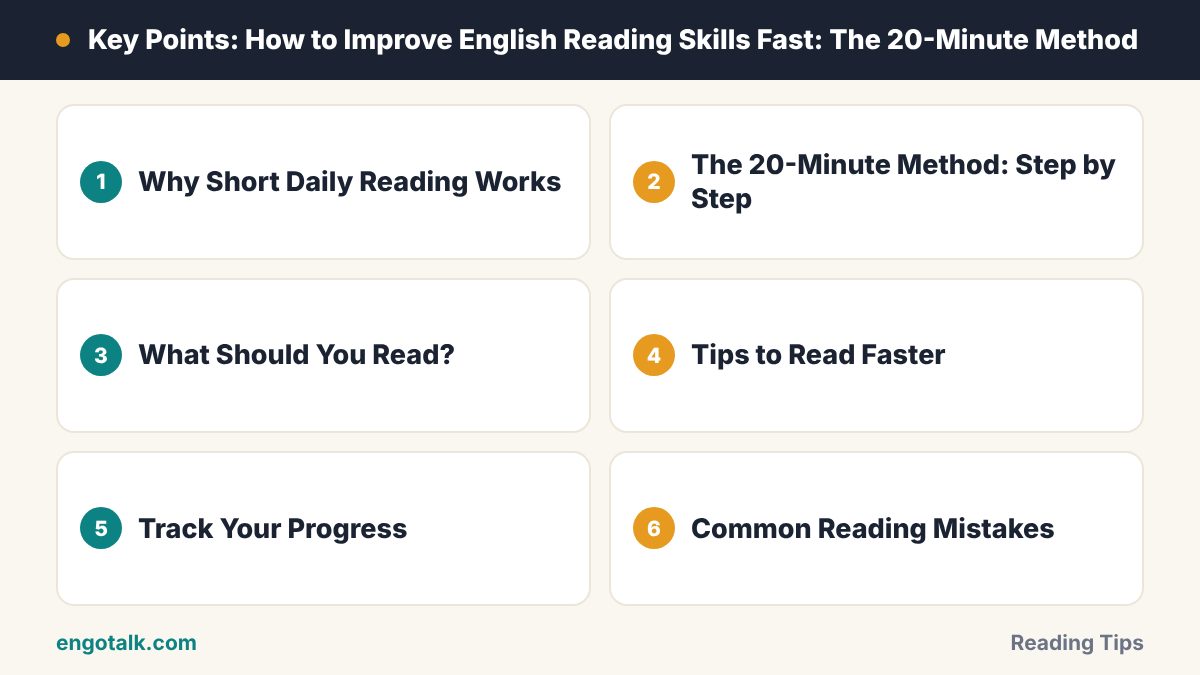
Why Short Daily Reading Works
Consistency beats intensity: 20 minutes every day is better than 3 hours once a week.
Better focus: Short sessions keep your attention high.
Easy to keep: You can fit 20 minutes into a commute, a lunch break or before bed.
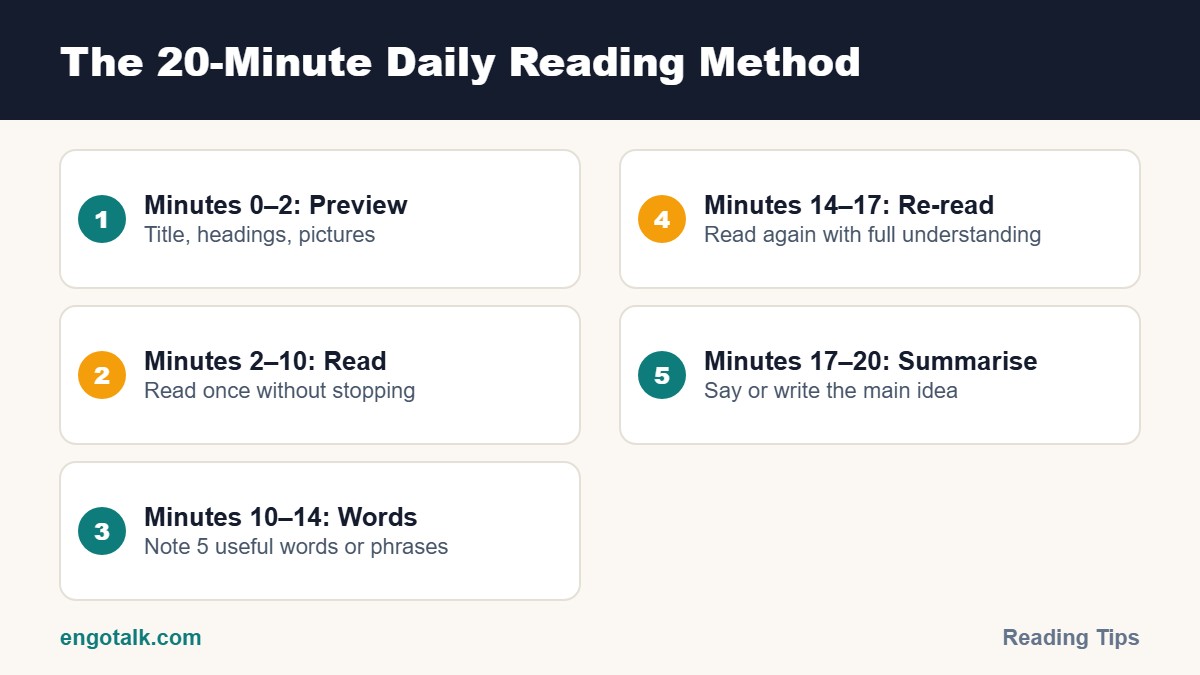
The 20-Minute Method: Step by Step
Step 1: Preview (2 minutes)
Before reading, look at the title, headings, pictures and the first sentence of each paragraph. Ask yourself: "What is this text probably about?" Previewing prepares your brain and makes reading faster.
Step 2: Read without stopping (8 minutes)
Read the whole text once without using a dictionary. Try to understand the general meaning. If you don't know a word, underline it and keep going. You will often understand it from context later.
Step 3: Collect useful words (4 minutes)
Go back to the underlined words. Choose only 5 useful words or phrases and check them in an English-English dictionary. Write them in a notebook with the sentence from the text. Learn more about building vocabulary through reading.
Step 4: Re-read (3 minutes)
Read the text again. This time, you will understand much more, and you will read faster. Re-reading is one of the most effective ways to build reading fluency.
Step 5: Summarise (3 minutes)
Close the text and say or write 2–3 sentences about the main idea. Summarising checks your understanding and also improves your speaking and writing.
What Should You Read?
Beginner: Graded readers, short stories and children's books. See best English story books for beginners.
Intermediate: Learner news sites, blogs and simple magazine articles.
Advanced: Newspapers, opinion articles and novels. Start with our guide on reading English newspapers.
A simple rule: if you don't understand more than 1 in 10 words on a page, the text is too difficult for daily practice.
Tips to Read Faster
Read in chunks: Look at groups of words ("in the morning", "at the end of") instead of single words.
Don't read aloud in your head for every word. It slows you down.
Use skimming and scanning when you need specific information. Learn how in our guide to skimming and scanning techniques.
Time yourself once a week to track progress.
Track Your Progress
Count the words in a short article.
Time how long it takes you to read it once.
Divide words by minutes to get your reading speed (words per minute).
Repeat every two weeks with a similar text.
Most learners see their speed and understanding improve noticeably within a month of daily practice.
Common Reading Mistakes
Stopping to look up every unknown word
Translating every sentence into your native language
Choosing texts that are far too difficult
Reading without a purpose or summary
Reading only when there is an exam
Turn Reading into Speaking on EngoTalk
A great way to remember what you read is to talk about it. On EngoTalk, you can share an interesting article with a partner or tutor on a live 1-on-1 video call and discuss it in English. Find a partner now.
Frequently Asked Questions
Is 20 minutes of reading a day enough?
Yes, if you read actively every day. Consistency matters more than long sessions.
Should I use a dictionary while reading?
Not during your first read. Read for meaning first, then check only a few important words.
How can I read English faster?
Read texts at your level, read in chunks of words, and re-read the same text to build fluency.
Will reading improve my IELTS score?
Yes. Daily reading improves vocabulary and speed, which are key for IELTS. See our IELTS Reading tips.
Test yourself: 5-question quiz
Check what you remember from this article. It takes about one minute, and you earn XP for completing it.