
Common English Grammar Mistakes Learners Make (and How to Fix Them)
Many English learners study English grammar for more than ten years at school, yet the same small mistakes keep appearing in their speaking and writing. This is not because they are weak learners. Most of these errors come from translating directly from your native language, or from phrases that are common in many countries but are not used in standard English.
In this guide, you will find the most common English grammar mistakes English learners make, why they happen, and simple ways to fix them for good. Each mistake includes a wrong and a correct example.
Why These Mistakes Happen
Every language has its own grammar rules. In many languages, verbs don't change for "he/she" the way English verbs do, many languages (such as Chinese, Japanese, Russian and Hindi) don't use articles like "a" and "the", and word order is often different. When we think in your native language and translate, these differences create errors. The good news is that once you notice a mistake, it is easy to fix with practice.
1. Subject–Verb Agreement
With he, she, it or a singular noun in the present simple tense, add -s or -es to the verb.
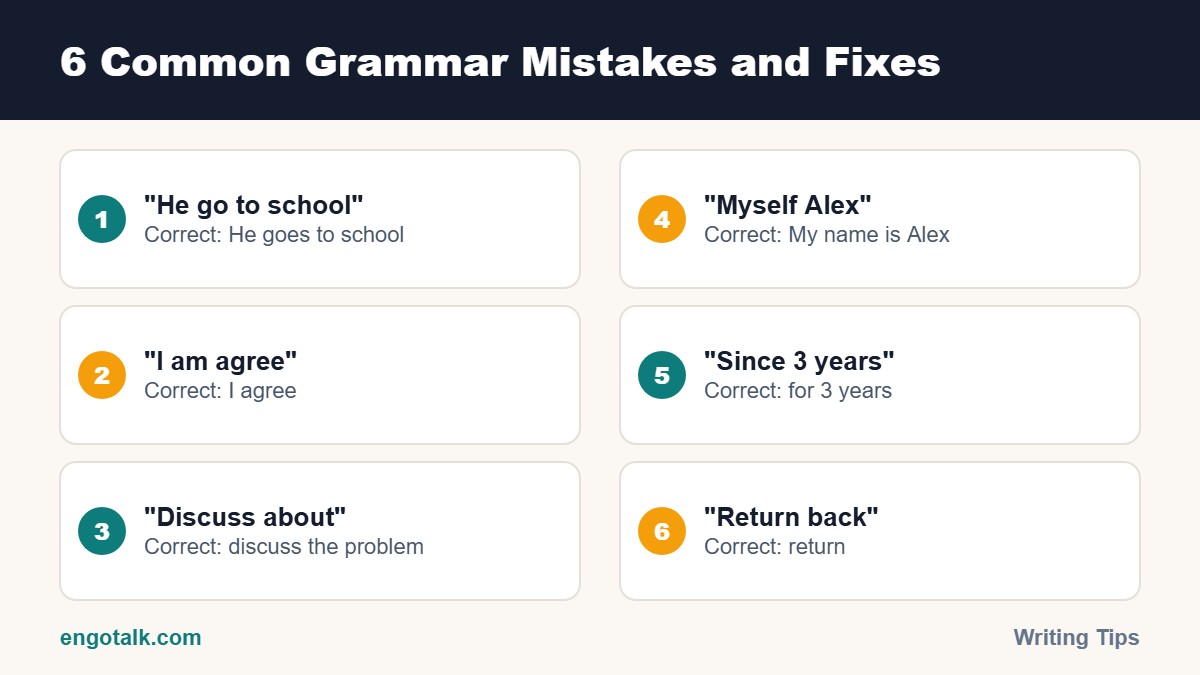
❌ He go to college every day.
✅ He goes to college every day.
❌ My sister work in a bank.
✅ My sister works in a bank.
2. "I am agree"
"Agree" is a verb, so it doesn't need "am".
❌ I am agree with you.
✅ I agree with you.
3. Extra Prepositions
Some verbs don't need a preposition after them.
❌ Let's discuss about the problem. → ✅ Let's discuss the problem.
❌ He entered into the room. → ✅ He entered the room.
❌ Please return back the book. → ✅ Please return the book.
4. "Myself Alex"
This introduction is common in some parts of South Asia, but it is not correct English.
❌ Myself Alex.
✅ My name is Alex. / I'm Alex.
5. "Since" vs "For"
Use for with a length of time and since with a starting point.
❌ I have lived in London since 5 years.
✅ I have lived in London for 5 years.
✅ I have lived in London since 2020.
6. Missing or Wrong Articles
Many languages have no articles, so "a", "an" and "the" are often forgotten.
❌ She is teacher. → ✅ She is a teacher.
❌ I saw a elephant. → ✅ I saw an elephant.
❌ Sun rises in east. → ✅ The sun rises in the east.
7. Wrong Tense with "Yesterday" and "Ago"
Use the past simple, not the present perfect, with finished time words.
❌ I have met him yesterday.
✅ I met him yesterday.
8. Double Comparatives
❌ This phone is more cheaper.
✅ This phone is cheaper.
9. Questions Without Auxiliary Verbs
❌ Where you live?
✅ Where do you live?
❌ Why he is late?
✅ Why is he late?
10. Uncountable Nouns
Some nouns cannot be made plural.
❌ Give me some informations. → ✅ some information
❌ I have many homeworks. → ✅ a lot of homework
❌ New furnitures → ✅ new furniture
How to Stop Making These Mistakes
Focus on 2–3 mistakes at a time. Trying to fix everything at once doesn't work.
Keep an error notebook. Write the wrong sentence and the correct version.
Read more English. Correct grammar becomes natural when you see it often. Try our 20-minute reading method.
Write a little every day. Short paragraphs are perfect practice. See how to write a paragraph in English.
Speak and get feedback. A partner or tutor can catch mistakes you don't notice.
Stop translating word by word. Learn to think directly in English.
Practise Correct English in Real Conversations
Grammar rules become automatic only when you use them often. On EngoTalk, you can practise speaking with peer learners and tutors on live 1-on-1 video calls and get friendly corrections in real time. Start a practice session now.
Frequently Asked Questions
Is "Myself Alex" wrong?
Yes. In standard English, say "My name is Alex" or "I'm Alex".
Should I learn grammar rules or just practise?
Both. Learn the rule once, then practise it many times in speaking and writing until it feels natural.
How long does it take to fix grammar mistakes?
If you focus on a few mistakes at a time and practise daily, you can fix most common errors in one to two months.
Do small grammar mistakes matter in speaking?
Small mistakes rarely stop communication, but fixing them makes you sound more confident and professional, especially in interviews and exams.
Test yourself: 5-question quiz
Check what you remember from this article. It takes about one minute, and you earn XP for completing it.