How to Build English Vocabulary Through Reading: 8 Simple Steps
Do you memorise long word lists, only to forget them a week later? You are not alone. Memorising words without context rarely works. One of the most effective and natural ways to build English vocabulary is reading.
When you read, you see words in real sentences, understand how they are used, and meet them again and again. In this guide, you will learn 8 simple steps to build your English vocabulary through reading, plus tools and a daily routine to make new words stick.
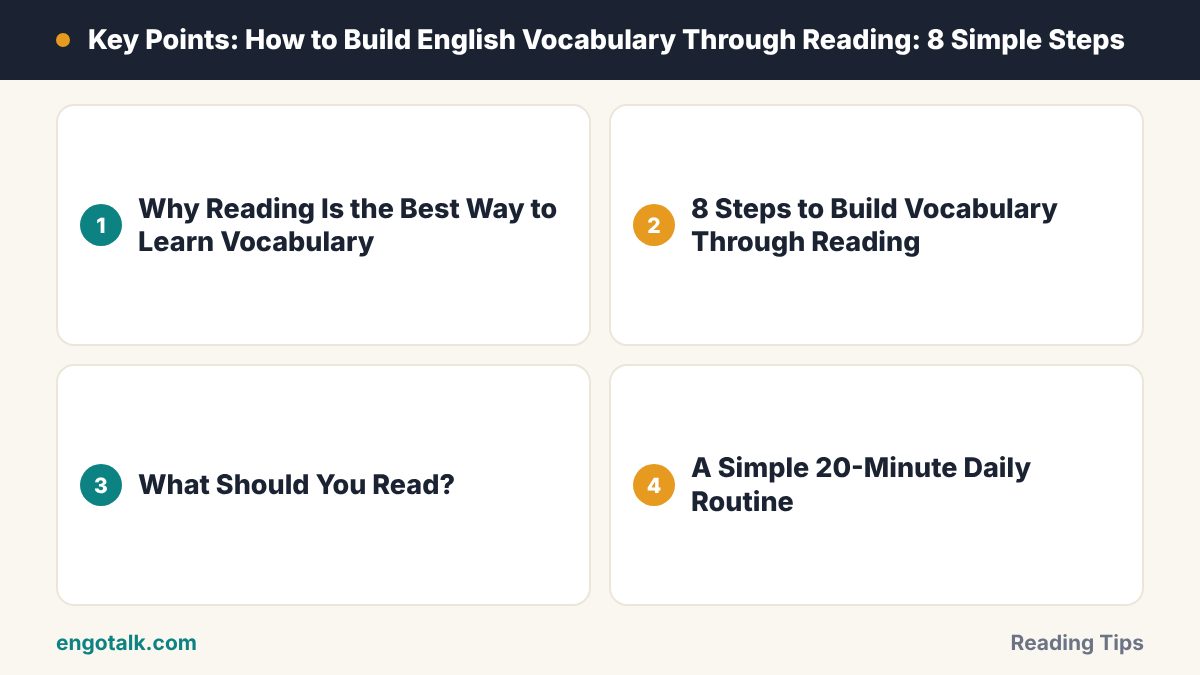
Why Reading Is the Best Way to Learn Vocabulary
Context: You learn what a word means and how it is used in a sentence.
Repetition: Common words appear again and again, so you remember them naturally.
Collocations: You learn which words go together, like "make a decision" or "heavy rain".
Grammar and spelling: You improve these at the same time, without extra effort.
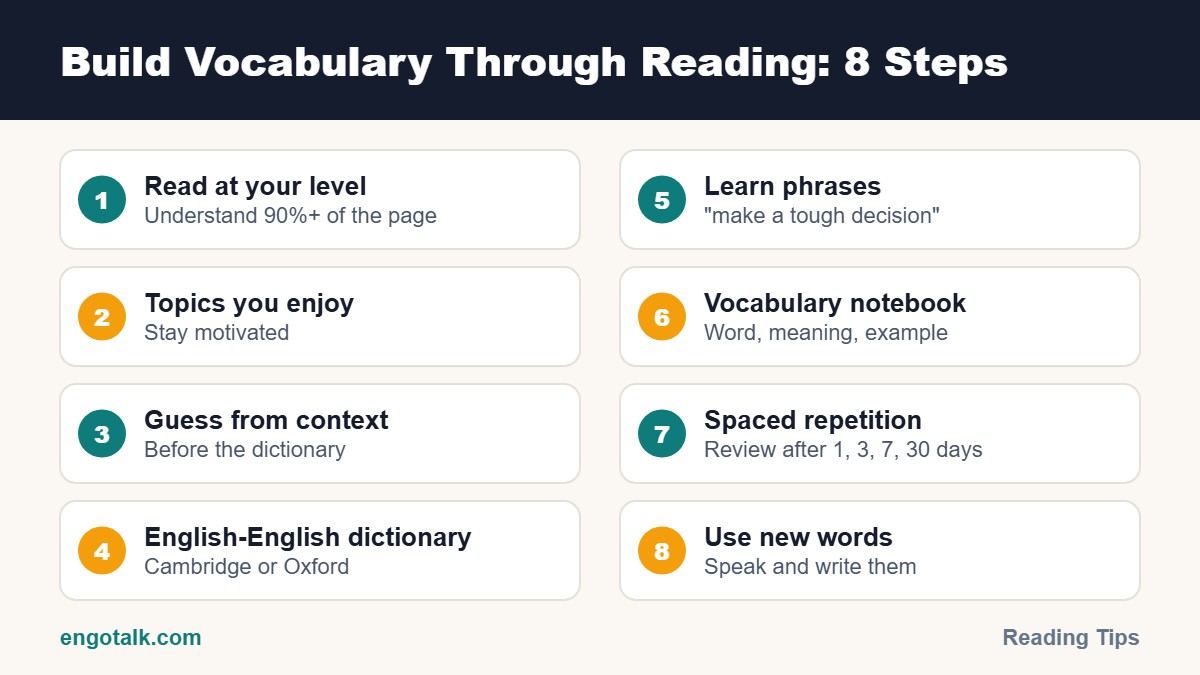
8 Steps to Build Vocabulary Through Reading
1. Choose material at the right level
If you don't understand more than 5–10% of the words on a page, the text is too hard. Choose material where you understand most of it, with only a few new words. Not sure where to start? See our guide to English story books for beginners.
2. Read about topics you enjoy
Football, technology, cooking, business or travel: reading about your interests keeps you motivated and helps you learn words you will actually use.
3. Guess the meaning from context first
Before opening a dictionary, try to guess the meaning from the sentence. For example: "After running for an hour, he was exhausted and fell asleep immediately." You can probably guess that "exhausted" means very tired.
4. Then check an English-English dictionary
Use a learner's dictionary like Cambridge or Oxford. English definitions help you think in English, and example sentences show you how to use the word.
5. Learn phrases, not just single words
Write down the full phrase from the text. Instead of "decision", write "make a tough decision". Phrases are easier to use in speaking and writing.
6. Keep a vocabulary notebook
For each new word, write:
The word or phrase
A simple English meaning
The sentence where you found it
Your own example sentence
7. Review with spaced repetition
Review new words after 1 day, 3 days, 1 week and 1 month. Apps like Anki or Quizlet make this easy. Spaced repetition moves words from short-term to long-term memory.
8. Use new words in speaking and writing
A word is truly yours only when you can use it. Try using 3–5 new words each day in a message, a short paragraph or a conversation.
What Should You Read?
Beginners: Graded readers, short stories and children's books.
Intermediate: News websites for learners, blogs and simple non-fiction.
Advanced: English newspapers, magazines, novels and opinion articles.
Reading the news is a great habit. Learn how in our guide on reading English newspapers as a beginner.
A Simple 20-Minute Daily Routine
10 minutes: Read an article or a few pages of a book.
5 minutes: Note 5 new words or phrases with their sentences.
5 minutes: Review old words and write one example sentence for each new one.
If you learn just 5 words a day, that is over 1,800 words in a year.
Common Mistakes to Avoid
Looking up every single unknown word, which kills your reading flow
Only translating words into your native language without learning how they are used
Never reviewing words after writing them down
Reading texts that are far too difficult
Learning words you will never use
Use Your New Vocabulary on EngoTalk
Reading helps you understand new words, but speaking helps you remember them. On EngoTalk, you can practise new vocabulary in real conversations with peer learners and tutors on live 1-on-1 video calls. Start a conversation today.
Frequently Asked Questions
How many new words should I learn per day?
5–10 words or phrases a day is a realistic target if you review them regularly.
Should I translate new words into your native language?
A quick translation can help, but always learn the English meaning and an example sentence too.
Is reading novels good for vocabulary?
Yes, especially for intermediate and advanced learners. Choose novels that match your level and interests.
How long does it take to see results?
With 20 minutes of daily reading and regular review, most learners notice a clear difference in 1–2 months.
Test yourself: 5-question quiz
Check what you remember from this article. It takes about one minute, and you earn XP for completing it.