
Stop Translating in Your Head: How to Think Directly in English
Do you build every English sentence in your native language first and then translate it word by word? Most learners do this at the beginning. The problem is that translation is slow, tiring and often produces unnatural English. It is one of the main reasons people pause, freeze or speak with many mistakes.
The good news is that thinking in English is a skill you can train. In this guide, you will learn why translating holds you back, 8 practical exercises to start thinking directly in English, and a simple 30-day plan.
Why Translating in Your Head Slows You Down
It takes time: Your brain does two jobs: building the sentence in your native language and then converting it.
Word order is different: Many languages put the verb at the end of the sentence; English doesn't.
Some expressions don't translate: Literal translations often sound strange. For example, the French expression "avoir le cafard" means "to feel down", but word for word it means "to have the cockroach".
It increases anxiety: You worry about finding the "right" translation instead of communicating.
8 Ways to Start Thinking in English
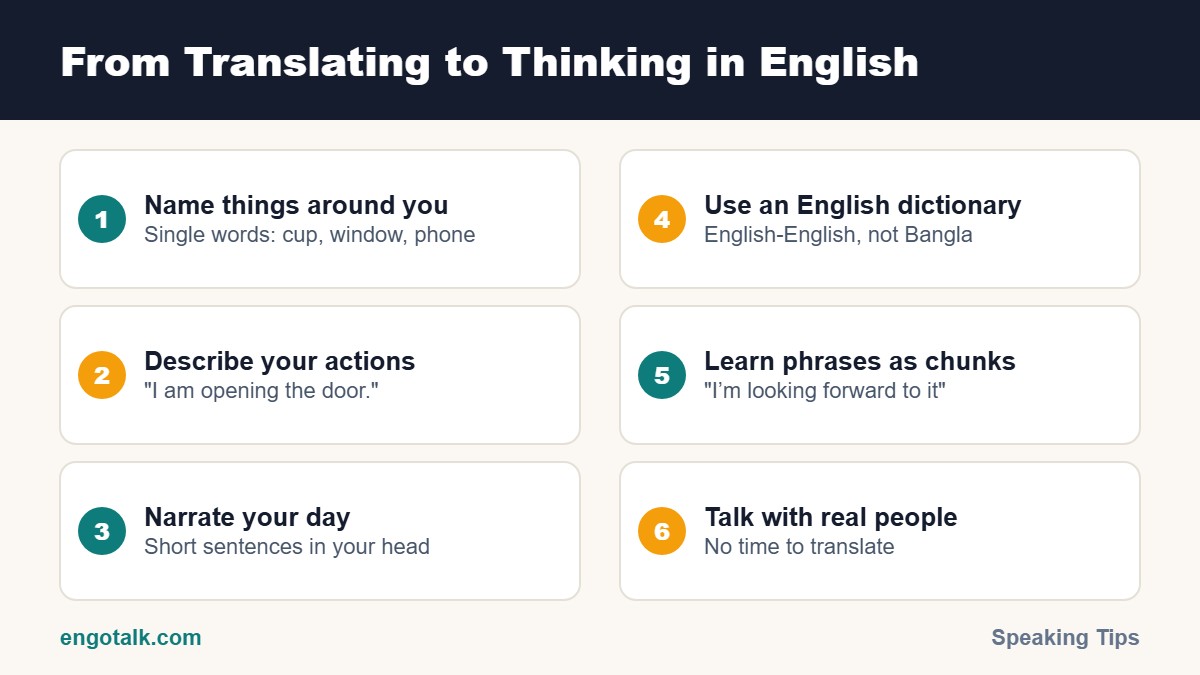
1. Name things around you
Start very simple. Look around and name objects in English: "window", "fan", "phone", "notebook". If you don't know a word, look it up and remember it.
2. Describe what you are doing
Narrate your actions in short sentences: "I'm making tea. I'm adding sugar. Now I'm drinking it." This builds automatic sentence patterns.
3. Plan your day in English
Each morning, think: "First, I'll go to class. Then I'll meet Alex. In the evening, I'll study." Simple future sentences become automatic quickly.
4. Use an English-English dictionary
Bilingual dictionaries keep you in translation mode. English definitions help you understand words directly in English.
5. Learn phrases as complete chunks
Learn "I'm looking forward to it" as one unit, not as separate words to translate. Chunks let you speak without building sentences from zero.
6. Talk to yourself
Practise short conversations out loud, like ordering food or introducing yourself. See 10 ways to practise English conversation without a partner.
7. Immerse yourself in English content
Change your phone language to English, follow English pages on social media and watch videos with English subtitles. Try our method for learning English with movies and TV shows.
8. Have real conversations
In live conversation there is simply no time to translate, so your brain learns to respond in English directly. It is uncomfortable at first, but it is the fastest way to break the translation habit.
A Simple 30-Day Plan
Week 1: Name 20 objects around you in English each day.
Week 2: Describe your actions in short sentences for 10 minutes a day.
Week 3: Plan your day and review your evening in English.
Week 4: Talk to yourself for 5 minutes daily and have at least two real conversations.
What to Do When You Don't Know a Word
Don't switch back to your native language. Describe it instead: "the thing you use to open a bottle" (a bottle opener). This skill, called paraphrasing, keeps you thinking in English and is very useful in exams like IELTS Speaking.
Common Mistakes
Expecting to stop translating completely in a few days
Trying to think complex thoughts in English too soon
Using only bilingual dictionaries
Practising only silently and never speaking out loud
Thinking in English is closely linked to fluency. Read our 10 daily habits for English fluency for more ideas.
Practise Thinking Fast in English on EngoTalk
On EngoTalk, you can join live 1-on-1 video calls with peer learners and tutors. Real conversations train your brain to respond in English directly, at your own level. Start a conversation now.
Frequently Asked Questions
How long does it take to stop translating?
Most learners start thinking simple thoughts in English within a few weeks of daily practice. Complex ideas take longer.
Is it bad to translate sometimes?
No. Translation can help you understand difficult words. The goal is to reduce translation when speaking.
What is the first step to thinking in English?
Start by naming objects and describing your daily actions in short, simple English sentences.
Does watching English content help me think in English?
Yes. The more English you hear and read, the more natural English thinking becomes.
Test yourself: 5-question quiz
Check what you remember from this article. It takes about one minute, and you earn XP for completing it.