
How to Read English Faster Without Losing Understanding
If English reading takes you twice as long as reading in your own language, you are not alone. Slow reading makes studying, exams and work emails tiring, and it often leads to running out of time in tests like IELTS. But reading faster doesn't mean skipping words or guessing. It means reading more efficiently.
In this guide, you will learn why you read slowly in English, 6 habits that increase reading speed without hurting understanding, a simple practice routine and how to measure your progress.
Why Do We Read Slowly in a Second Language?
Reading word by word instead of in groups of words.
Inner voice: "saying" every word in your head.
Regression: going back to re-read sentences again and again.
Limited vocabulary: stopping at unknown words.
Translating each sentence into your native language.
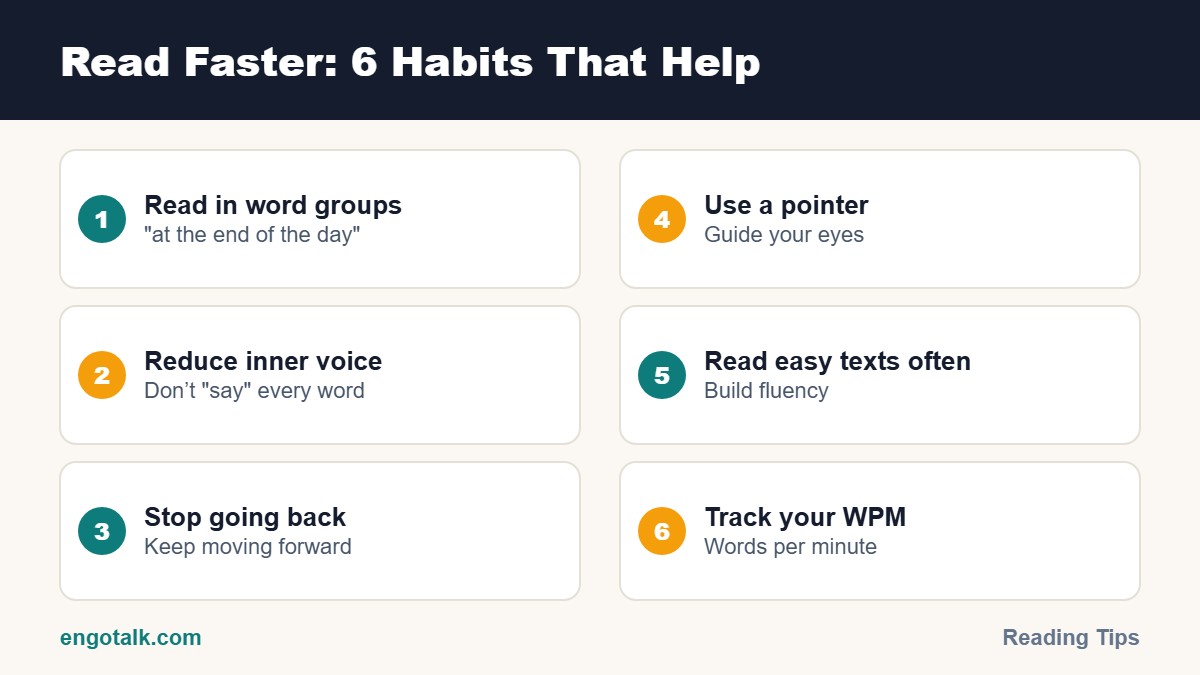
6 Habits to Read Faster
1. Read in word groups (chunks)
Train your eyes to see groups of words like "at the end of the day", "as a result of" or "in the morning". Phrases carry meaning, so reading in chunks is both faster and clearer.
2. Reduce your inner voice
Most people hear a voice in their head while reading. It's normal, but it limits your speed to speaking speed. Try reading a little faster than you can comfortably "say" the words, focusing on meaning instead of sound.
3. Stop going back
Many readers jump back to re-read sentences out of habit, not because they need to. Keep moving forward. Often the next sentence explains what you didn't understand.
4. Use a pointer
Move a finger or pen under the line as you read. It guides your eyes and prevents them from jumping back.
5. Read easy texts often
Speed comes from fluency. Reading easy, enjoyable texts every day builds automatic word recognition. Try graded readers or stories from our list of English story books.
6. Grow your vocabulary
The more words you recognise instantly, the faster you read. See how to build vocabulary through reading.
Know When to Slow Down
Fast reading is not always the goal. Read slowly and carefully when you are studying difficult material, reading contracts or instructions, or answering detailed exam questions. For quick searches, use skimming and scanning instead.
A 10-Minute Daily Speed Practice
2 minutes: Read an easy text with a pointer, slightly faster than usual.
5 minutes: Read a new text in word groups without going back.
3 minutes: Write a short summary to check understanding.
How to Measure Your Reading Speed
Choose a text of about 300–400 words.
Time yourself reading it once.
Divide the number of words by the minutes to get words per minute (WPM).
Answer a few questions or summarise it to check understanding.
Test again every two weeks with a similar text.
Speed only counts if comprehension stays high. If your summary is weak, slow down slightly. Our guide on reading comprehension strategies can help.
Faster Reading for Exams
In IELTS and similar tests, reading speed is critical. Combine these habits with a clear time plan. See our IELTS Reading tips to finish on time.
Discuss What You Read on EngoTalk
Explaining an article quickly in your own words is great practice for both reading and speaking. On EngoTalk, you can do this with partners and tutors on live 1-on-1 video calls. Start practising now.
Frequently Asked Questions
What is a good English reading speed?
Many native adults read roughly 200–300 words per minute. For learners, steady improvement matters more than a specific number.
Does speed reading reduce understanding?
Extreme speed reading can. The goal is efficient reading, faster while still understanding the main ideas.
How long does it take to read faster?
With 10 minutes of daily practice, many learners notice a difference in a few weeks.
Should I stop the inner voice completely?
No. Just try not to "say" every single word. Focus on meaning and phrases.
Test yourself: 5-question quiz
Check what you remember from this article. It takes about one minute, and you earn XP for completing it.