
IELTS Reading Tips: How to Finish on Time and Score Band 7+
The biggest problem most students face in IELTS Reading is not difficult vocabulary. It is time. You get 60 minutes for 3 long passages and 40 questions, and there is no extra time to transfer answers. Many students around the world know the answers but simply run out of time.
In this guide, you will learn how the IELTS Reading test works, a time plan that actually works, strategies for every major question type, and the mistakes that stop students from reaching Band 7.
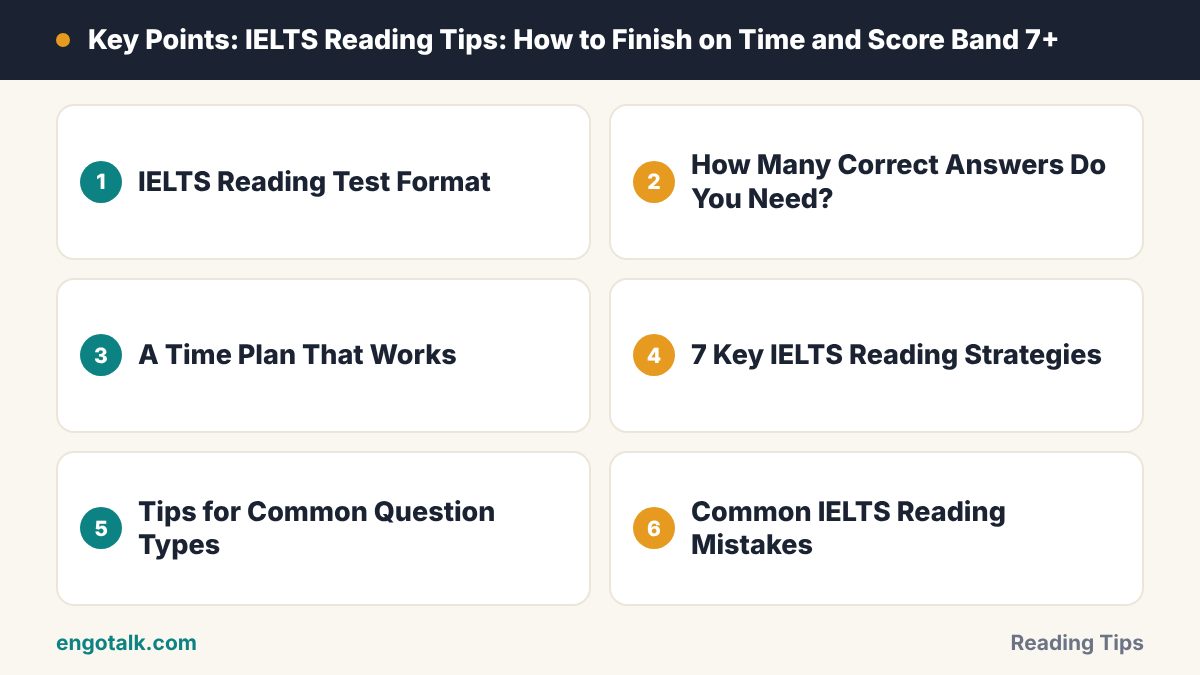
IELTS Reading Test Format
Time: 60 minutes, with no extra transfer time.
Passages: 3 long texts, usually 700–900 words each, getting harder from Passage 1 to Passage 3.
Questions: 40 in total.
Academic vs General Training: Academic uses texts from books, journals and magazines. General Training uses everyday and work-related texts.
How Many Correct Answers Do You Need?
For IELTS Academic Reading, you need roughly 30 out of 40 for Band 7 and about 35 for Band 8. General Training needs a few more correct answers for the same band.
A Time Plan That Works
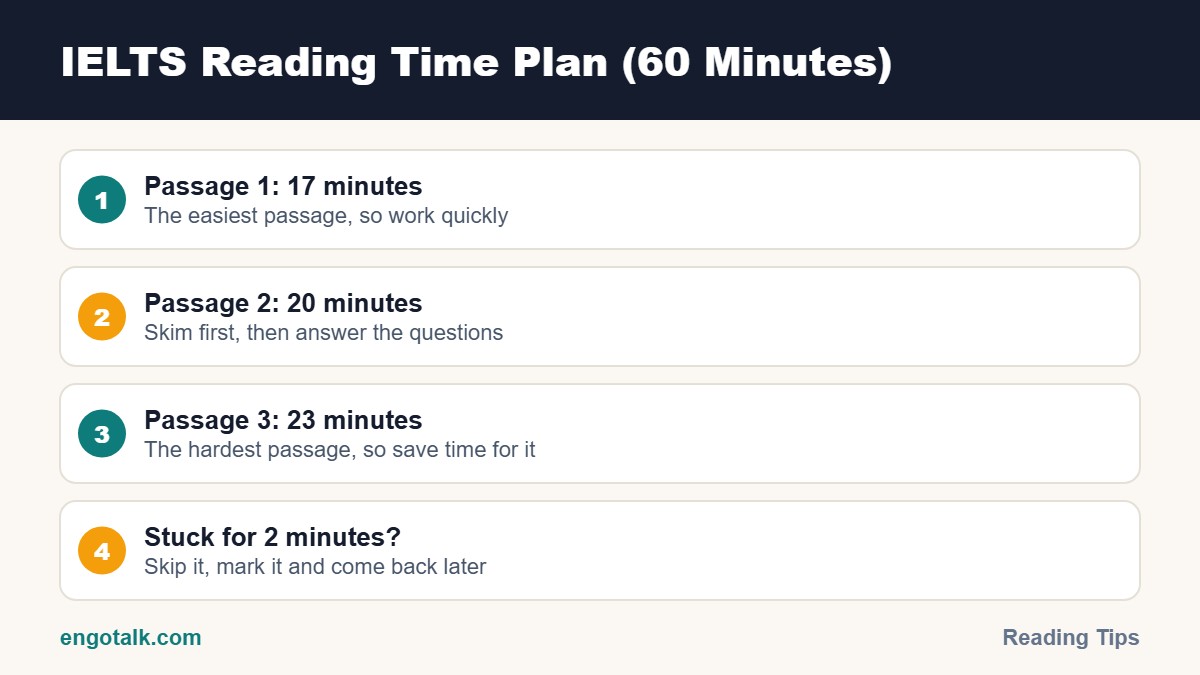
Passage 1: 17 minutes
Passage 2: 20 minutes
Passage 3: 23 minutes
Passage 3 is the hardest, so save more time for it. If a question takes more than 1–2 minutes, skip it, mark it, and come back later.
7 Key IELTS Reading Strategies
1. Don't read every word first
Reading the whole passage carefully before looking at questions wastes time. Skim the passage in 2–3 minutes to understand the main idea of each paragraph.
2. Master skimming and scanning
Skimming means reading quickly for the general idea. Scanning means searching for specific information like names, dates and numbers. Learn both in our guide to skimming and scanning techniques.
3. Read the questions carefully and underline keywords
Underline the keywords in each question, especially names, numbers and words that are hard to paraphrase.
4. Look for paraphrases
The passage rarely uses the same words as the question. "Children" may become "young people", and "increase" may become "rise" or "growth". Train yourself to recognise synonyms.
5. Answers usually follow passage order
For most question types (except matching headings and some matching tasks), answers appear in the same order as the passage. Use this to save time.
6. Follow the word limit
If the instruction says "NO MORE THAN TWO WORDS", writing three words makes the answer wrong.
7. Never leave a blank
There is no negative marking. If you are running out of time, guess. A guess might be correct; a blank never is.
Tips for Common Question Types
True / False / Not Given
True: The passage says the same thing.
False: The passage says the opposite.
Not Given: The passage does not give this information.
Don't use your own knowledge. Only use what the passage says.
Matching Headings
Read the first and last sentences of each paragraph to find the main idea. Do this question type first, as it helps you understand the whole passage.
Sentence and Summary Completion
Predict the type of word you need (noun, verb, adjective, number), then scan for it. Check grammar after filling the gap.
Multiple Choice
Find the part of the passage the question refers to, then eliminate wrong options one by one.
Common IELTS Reading Mistakes
Spending too long on one difficult question
Confusing "False" with "Not Given"
Spelling words incorrectly when copying from the passage
Choosing an answer just because it uses the same word as the passage
Not practising with a timer
Build Reading Speed Outside the Exam
The best way to improve IELTS Reading is to read English every day: news, articles and stories. Try our 20-minute reading method or start with reading English newspapers.
Practise Your English with EngoTalk
Strong reading skills go hand in hand with strong speaking and vocabulary. On EngoTalk, you can discuss articles and topics with peer learners and tutors on live 1-on-1 video calls, the perfect way to use new vocabulary actively. Start practising today.
Frequently Asked Questions
How can I finish IELTS Reading on time?
Follow a time plan (17–20–23 minutes), skim before answering, and skip difficult questions to come back to later.
What is the difference between False and Not Given?
False means the passage says the opposite. Not Given means the passage does not mention the information at all.
Is IELTS Reading harder than Listening?
Many students find Reading harder because of time pressure, but with daily practice both can reach Band 7 or higher.
How many passages should I practise each day?
One timed passage a day with careful review of every mistake is enough to see steady progress.
Test yourself: 5-question quiz
Check what you remember from this article. It takes about one minute, and you earn XP for completing it.