Skimming and Scanning Techniques for English Reading: How to Use Them
Do you read every English text slowly from the first word to the last? Then you are probably spending too much time on reading, especially in exams like IELTS. Good readers don't read everything in the same way. They change their speed depending on what they need.
Two of the most useful reading techniques are skimming and scanning. In this guide, you will learn what they are, the difference between them, step-by-step methods, practice exercises, and how to use them in exams and daily life.
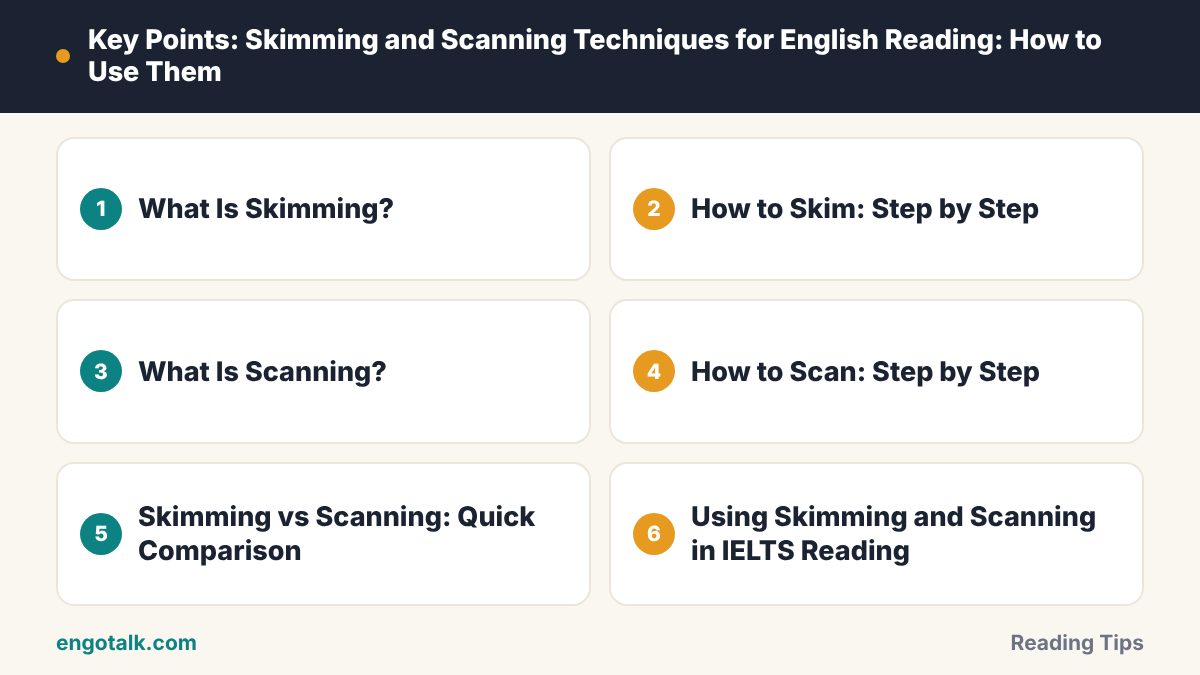
What Is Skimming?
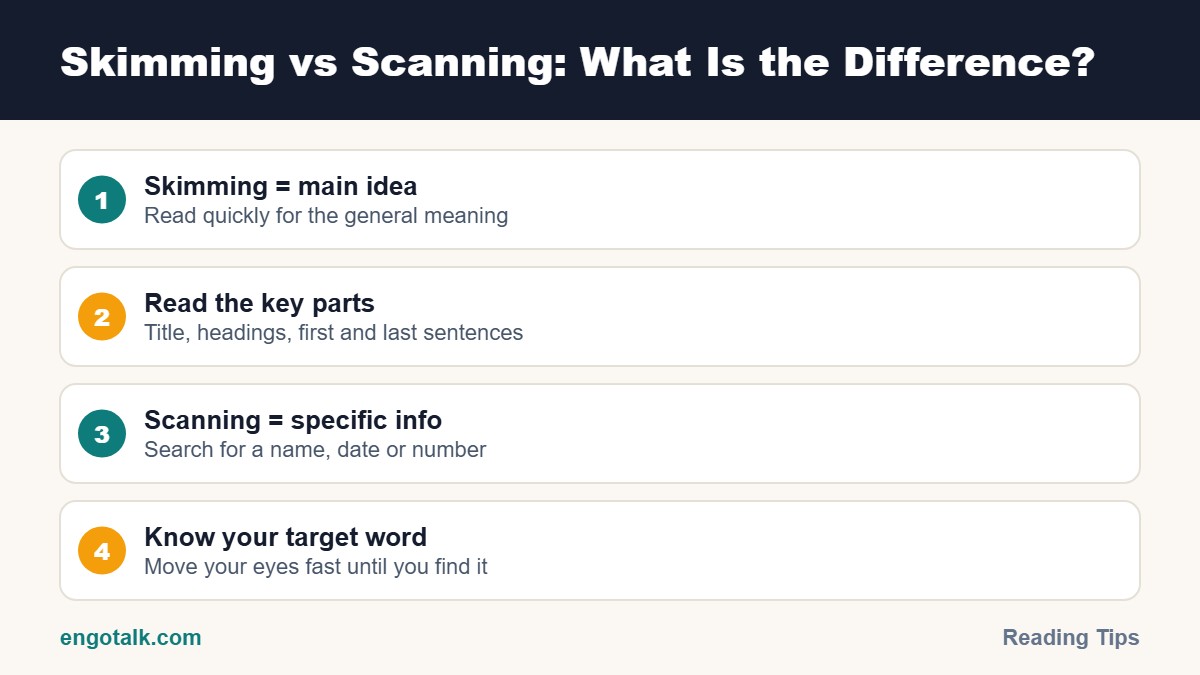
Skimming means reading quickly to understand the general idea of a text. You don't read every word. You look at the most important parts to answer the question: "What is this text mostly about?"
Use skimming when you want to:
Decide if an article is useful
Get the main idea before reading in detail
Match headings to paragraphs in IELTS
Review a chapter before an exam
How to Skim: Step by Step
Read the title and subtitle.
Look at headings, bold words and pictures.
Read the first paragraph (introduction) fully.
Read the first sentence of every other paragraph. This is usually the topic sentence.
Read the last paragraph (conclusion).
A 700-word article can be skimmed in about 1–2 minutes this way.
What Is Scanning?
Scanning means searching quickly for specific information, like a name, date, number or keyword. You already know what you are looking for; you just need to find where it is.
Use scanning when you want to:
Find a train time in a timetable
Look up a word in a dictionary
Find a specific fact to answer an exam question
Check a price on a menu
How to Scan: Step by Step
Decide exactly what you are looking for. For example, "the year", "a person's name", "a percentage".
Think about what it looks like. Dates have numbers; names start with capital letters.
Move your eyes quickly over the text without reading every word.
Stop when you find it, then read that sentence carefully.
Skimming vs Scanning: Quick Comparison
Purpose: Skimming finds the main idea; scanning finds a specific detail.
What you read: Skimming uses headings and key sentences; scanning looks for a target word or number.
When: Skimming usually comes first; scanning comes when you answer questions.
Using Skimming and Scanning in IELTS Reading
Skim the passage in 2–3 minutes to understand what each paragraph is about.
Read the questions and underline keywords.
Scan the passage for those keywords or their synonyms.
Read the surrounding sentences carefully to choose the answer.
For a full exam strategy, read our IELTS Reading tips to finish on time.
Practice Exercises
Skimming practice: Take a news article and give yourself 60 seconds. Then write one sentence about the main idea. Our guide on reading English newspapers will help you choose articles.
Scanning practice: Open a long article and find all the numbers or names in 30 seconds.
Combined practice: Skim an article, then write 3 questions about details and scan to answer them.
When NOT to Skim or Scan
Some texts need careful reading: contracts, instructions, exam questions and texts you are studying in detail. For these, read slowly and completely. For daily reading practice, try the 20-minute reading method.
Discuss What You Read on EngoTalk
Skimming an article and explaining it to someone is great speaking practice. On EngoTalk, you can discuss articles with peer learners and tutors on live 1-on-1 video calls. Start a session now.
Frequently Asked Questions
What is the main difference between skimming and scanning?
Skimming is reading quickly for the main idea. Scanning is searching quickly for specific information.
Which should I do first in an exam?
Skim the passage first to understand its structure, then scan for answers to each question.
Does skimming reduce understanding?
Skimming gives you the general idea, not every detail. Use careful reading when details matter.
How can I get better at scanning?
Practise finding names, dates and numbers in timetables, menus and news articles against a timer.
Test yourself: 5-question quiz
Check what you remember from this article. It takes about one minute, and you earn XP for completing it.