
How to Improve English Reading Comprehension: 8 Strategies That Work
Have you ever read a full page in English, understood almost every word, and still had no idea what the text was really about? This is a very common problem. Reading comprehension is not just about knowing words. It is about understanding ideas, connections and the writer's purpose.
In this guide, you will learn 8 practical reading comprehension strategies, how to use them before, during and after reading, and simple exercises to build the skill step by step.
What Is Reading Comprehension?
Reading comprehension is your ability to understand, interpret and remember what you read. Good readers don't just decode words. They connect ideas, notice the main point, make predictions and ask questions as they read.
Before You Read
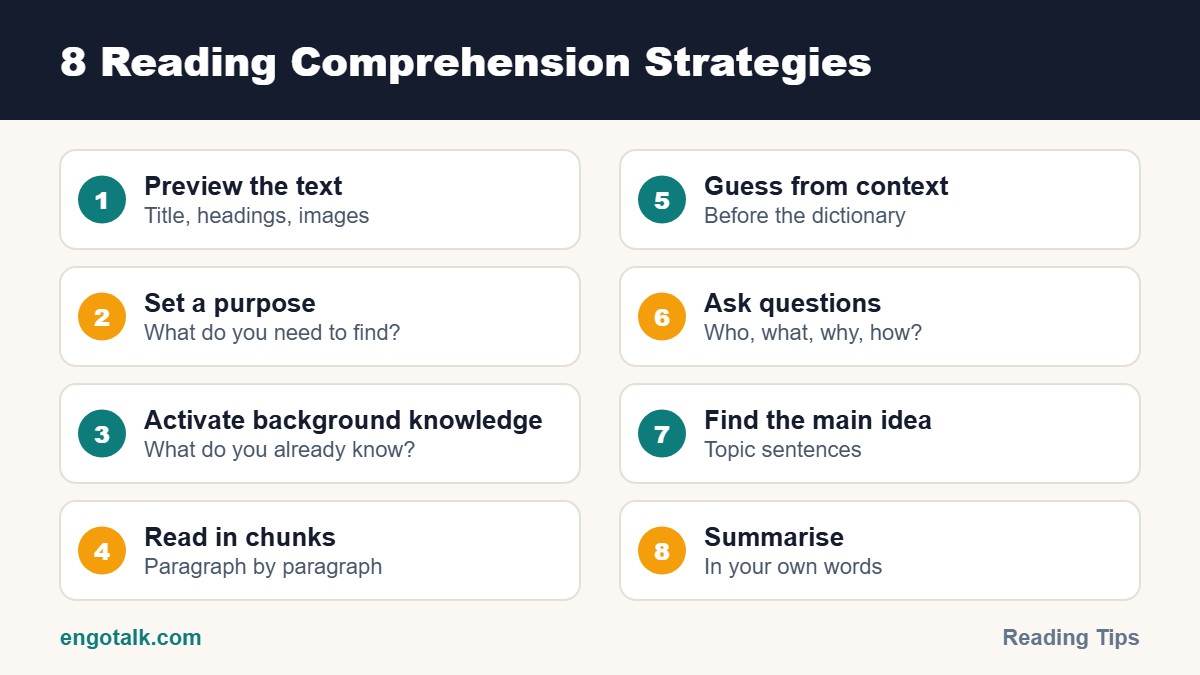
1. Preview the text
Look at the title, headings, images and first and last paragraphs. In one minute, you can usually predict what the text is about. Our guide to skimming and scanning explains how.
2. Set a purpose
Ask yourself why you are reading. To find a fact? To understand an argument? To enjoy a story? Your purpose decides how carefully you read.
3. Activate background knowledge
Think about what you already know about the topic. Connecting new information to old knowledge makes it easier to understand and remember.
While You Read
4. Read in chunks
Read one paragraph at a time, then pause and ask: "What was this paragraph about?" If you can't answer, read it again.
5. Guess meaning from context
When you meet a new word, look at the words around it before using a dictionary. Often the sentence explains the meaning. Learn more in how to build vocabulary through reading.
6. Ask questions
Active readers ask: Who is this about? What is the main argument? Why does the writer think this? How does this connect to the previous paragraph?
7. Find the main idea
Most paragraphs have a topic sentence, usually the first one, that states the main idea. Underline it. Notice linking words like "however", "therefore" and "for example", which show how ideas connect.
After You Read
8. Summarise in your own words
Close the text and write or say 3–5 sentences about the main points. If you can summarise it, you have understood it.
Simple Comprehension Exercises
One-sentence summary: After each article, write one sentence that captures the main idea.
Question writing: Write 3 questions about a text, then answer them without looking.
Fact vs opinion: Highlight facts in one colour and opinions in another.
Retelling: Explain an article to a friend in English.
Common Reasons for Poor Comprehension
Reading word by word instead of in phrases
Choosing texts that are far too difficult
Translating every sentence
Not paying attention to linking words
Reading without a purpose
For a daily routine that builds comprehension, try the 20-minute reading method. Preparing for an exam? Read our IELTS Reading tips.
Discuss What You Read on EngoTalk
Talking about a text is one of the best ways to check your understanding. On EngoTalk, you can discuss articles and stories with partners and tutors on live 1-on-1 video calls. Start a session now.
Frequently Asked Questions
Why can I understand words but not the whole text?
Comprehension needs more than vocabulary. You also need to notice the main idea, connections between sentences and the writer's purpose.
How can I improve reading comprehension quickly?
Read daily at the right level, preview texts, ask questions while reading and summarise afterwards.
Does reading aloud help comprehension?
It can help with focus and pronunciation, but silent reading is usually faster for understanding longer texts.
What should I read to improve comprehension?
Choose interesting texts at your level, such as news for learners, blogs and graded readers.
Test yourself: 5-question quiz
Check what you remember from this article. It takes about one minute, and you earn XP for completing it.