How to Read English Newspapers as a Beginner: A Step-by-Step Guide
Reading English newspapers is one of the best ways to improve your vocabulary, grammar and general knowledge at the same time. But for many beginners, news articles feel difficult: the headlines are confusing, the sentences are long, and there are many new words.
The secret is to start small and read with a method. In this guide, you will learn which newspapers to start with, how a news article is organised, a 5-step reading method and useful tips to understand headlines.
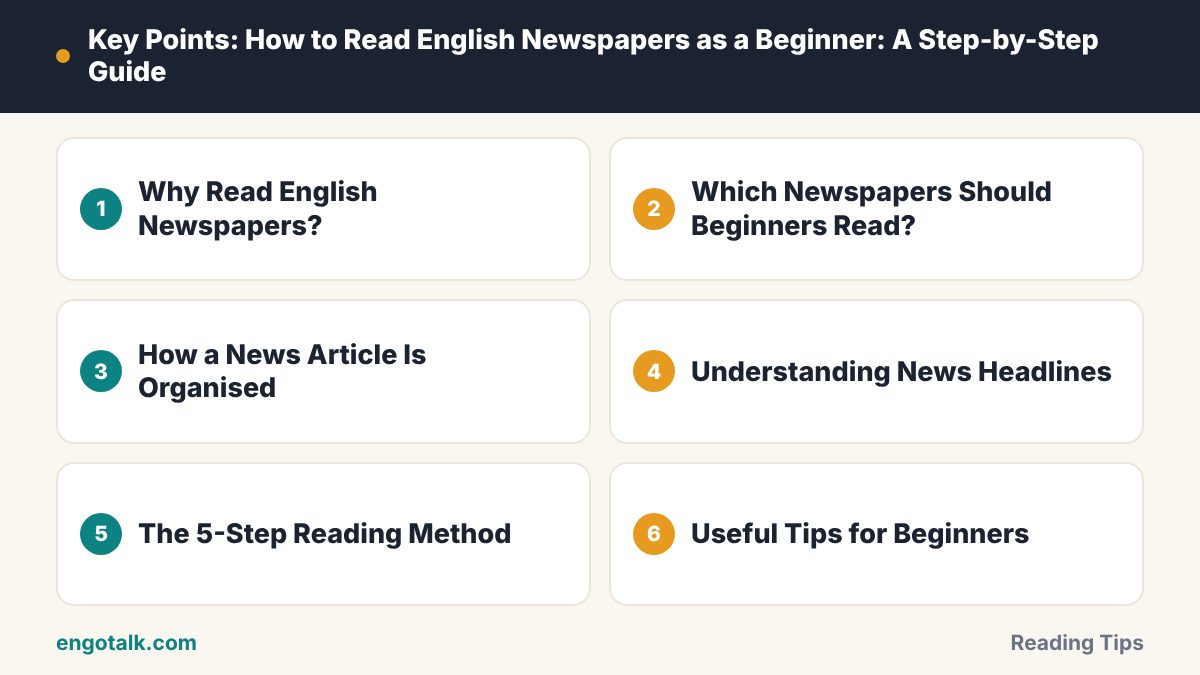
Why Read English Newspapers?
Real, up-to-date English: You learn words people use today.
Formal grammar: News articles use clear, correct sentences.
General knowledge: Useful for interviews, IELTS Speaking and Writing.
Daily habit: There is always something new to read.
Which Newspapers Should Beginners Read?
Learner news sites: BBC Learning English ("News Review"), News in Levels and Breaking News English rewrite real news in simpler English.
Local English-language newspapers: Many countries have an English-language newspaper that reports on topics you already know, which makes understanding easier.
International news: BBC News, Reuters and The Guardian once you feel more confident.
Start with local news or topics you already know in your native language. Background knowledge makes English articles much easier to understand.
How a News Article Is Organised
Most news articles use the inverted pyramid structure. The most important information comes first, and details come later.
Headline: The main point in a few words.
First paragraph (lead): Who, what, where, when and sometimes why.
Body: Details, quotes and background.
End: Less important information.
This means you can understand the main story just by reading the headline and the first paragraph.
Understanding News Headlines
Headlines use a special short style:
Present tense for past events: "PM visits Japan" means the PM visited or is visiting Japan.
"To" for the future: "Government to raise fuel prices" means it will raise them.
Small words are removed: "Fire in city market" instead of "There was a fire in a market in the city".
Short dramatic words: "slams" (strongly criticises), "row" (argument), "bid" (attempt), "hike" (increase).
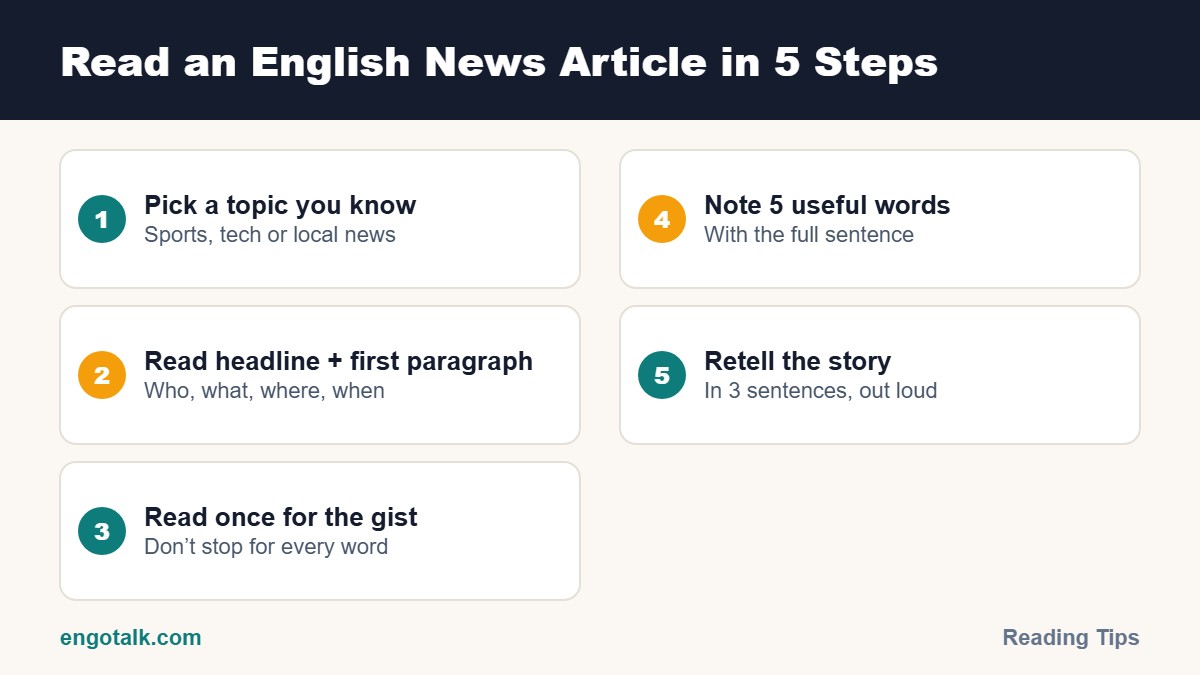
The 5-Step Reading Method
Step 1: Choose a topic you know
Sports, technology, entertainment or local news are easier than economics or politics at first.
Step 2: Read the headline and first paragraph
Try to answer: Who? What? Where? When?
Step 3: Read the whole article once
Don't stop for every unknown word. Focus on the general meaning. If you need a specific detail, use skimming and scanning.
Step 4: Note 5 useful words
Choose words or phrases you will see again. Write them with the sentence from the article. Here's more on building vocabulary through reading.
Step 5: Retell the story
Say or write 3 sentences about the article in your own words. This turns reading into speaking and writing practice.
Useful Tips for Beginners
Read one short article a day rather than a full newspaper once a week.
Read the same story in your native language first if it is very difficult, then read it in English.
Follow a news story over several days. The same words will repeat.
Combine news reading with the 20-minute reading method.
Talk About the News on EngoTalk
Discussing the news is a great way to practise speaking and opinions, which are key in IELTS Speaking Part 3 and job interviews. On EngoTalk, you can discuss current topics with peer learners and tutors on live 1-on-1 video calls. Join a session.
Frequently Asked Questions
Which English newspaper is best for beginners?
Learner sites like News in Levels and BBC Learning English are best at first. Then try BBC News or The Guardian.
How many articles should I read each day?
One short article read carefully is enough for beginners.
Why are headlines so hard to understand?
Headlines use short forms, present tense and special words. Once you learn these patterns, they become much easier.
Can reading newspapers help IELTS?
Yes. It builds vocabulary, reading speed and ideas for Writing and Speaking topics.
Test yourself: 5-question quiz
Check what you remember from this article. It takes about one minute, and you earn XP for completing it.