
How to Read Academic Articles in English: A Guide for University Students

For many international students, academic reading is the biggest shock of studying in English. Journal articles are long, full of technical vocabulary and written in a formal, complex style. Reading them word by word from start to finish can take hours, and you may still miss the main point.
The good news is that experienced researchers don't read academic articles that way either. In this guide, you will learn how academic articles are structured, the smart order to read them in, how to handle academic vocabulary and how to take useful notes.
How Academic Articles Are Structured
Most research articles follow a similar structure, often called IMRaD:
Abstract: a short summary of the whole study.
Introduction: the background, the problem and the research question.
Methods: how the research was done.
Results: what the researchers found.
Discussion/Conclusion: what the results mean and their limitations.
Don't Read from Start to Finish
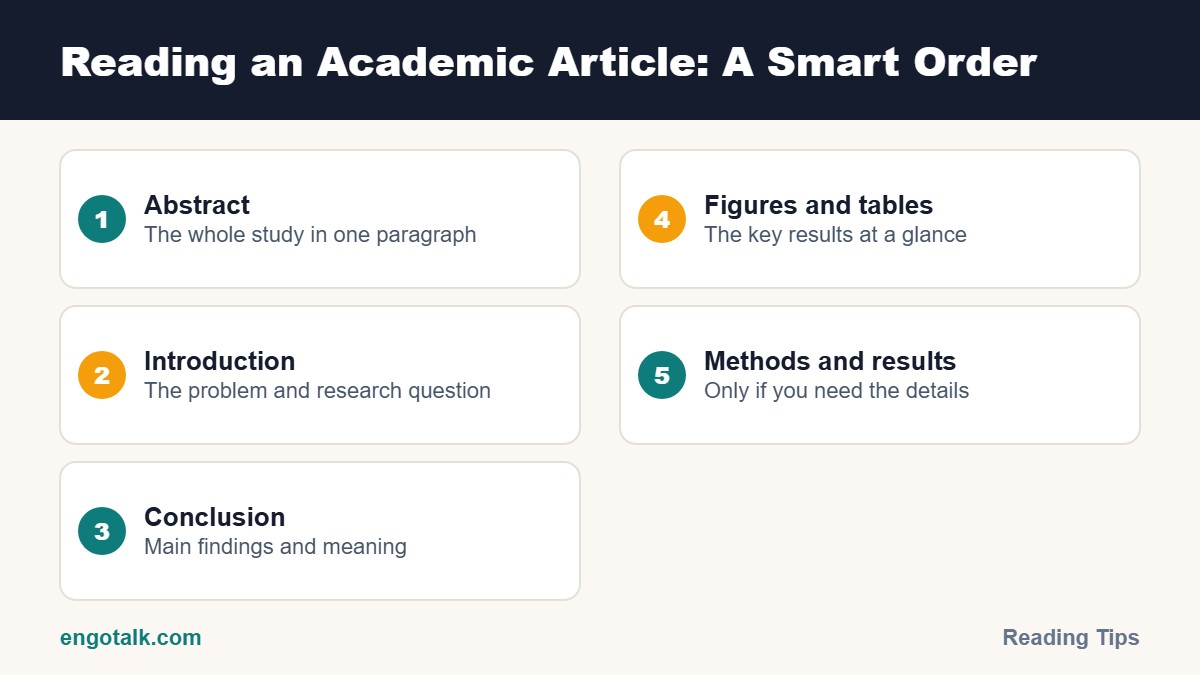
Instead, read in this order:
Title and abstract: Decide if the article is relevant.
Introduction: Focus on the last paragraph, which often states the aim.
Conclusion: Find the main findings.
Figures and tables: See the key results visually.
Methods and results: Read in detail only if you need them.
This approach can save hours and helps you understand the big picture first. It uses the same ideas as skimming and scanning.
Understanding Academic Vocabulary
Learn the Academic Word List (AWL): a well-known list of words common in academic texts, such as "analyse", "significant", "approach" and "factor".
Learn subject-specific terms from your field's textbooks and glossaries.
Notice hedging language: words like "may", "suggest", "appear to" and "likely" show the writer is being careful, not certain.
Keep a vocabulary log with the term, a simple definition and an example. See how to build vocabulary through reading.
Handling Long, Complex Sentences
Find the main subject and verb first.
Put extra information in brackets in your mind (clauses beginning with "which", "that", "although").
Notice linking words: "however" (contrast), "therefore" (result), "moreover" (addition).
Rewrite difficult sentences in simple English in your notes.
Taking Useful Notes
Write the full reference (authors, year, title) at the top.
Note the research question, method, main findings and limitations.
Add your own comments: Do you agree? How is it useful for your assignment?
Summarise the article in 3–5 sentences in your own words to avoid plagiarism later.
Common Mistakes
Reading every article in full, even irrelevant ones
Highlighting everything instead of the key points
Copying sentences instead of summarising
Ignoring tables and figures
Not checking when the article was published
For general reading comprehension skills, read 8 reading comprehension strategies, and to save time, see how to read English faster. Writing an assignment next? Our guide on how to write an essay in English will help.
Practise Academic Discussion on EngoTalk
Explaining a research article out loud is excellent preparation for seminars and presentations. On EngoTalk, you can practise academic discussions with tutors on live 1-on-1 video calls. Start practising now.
Frequently Asked Questions
Do I need to read the whole academic article?
Not always. Start with the abstract, introduction and conclusion, and read the rest only if you need the details.
What is the Academic Word List?
It is a list of words that appear frequently across many academic subjects, useful for university-level reading and writing.
How can I understand difficult academic sentences?
Find the main subject and verb, ignore extra clauses at first, and rewrite the sentence in simple words.
How do I take notes from a research article?
Note the research question, method, findings and limitations, then summarise in your own words.
Test yourself: 5-question quiz
Check what you remember from this article. It takes about one minute, and you earn XP for completing it.