How to Improve English Listening Skills for Beginners: A Simple Guide
If you are a beginner, listening to English can feel like trying to catch water with your hands. The words go past too fast, and you understand only a few of them. This is completely normal. Every English speaker, including native children, started by understanding very little.
The key is to start at the right level and build up step by step. In this beginner's guide, you will learn why listening feels hard at first, what to listen to, a simple daily routine and how to stay motivated.
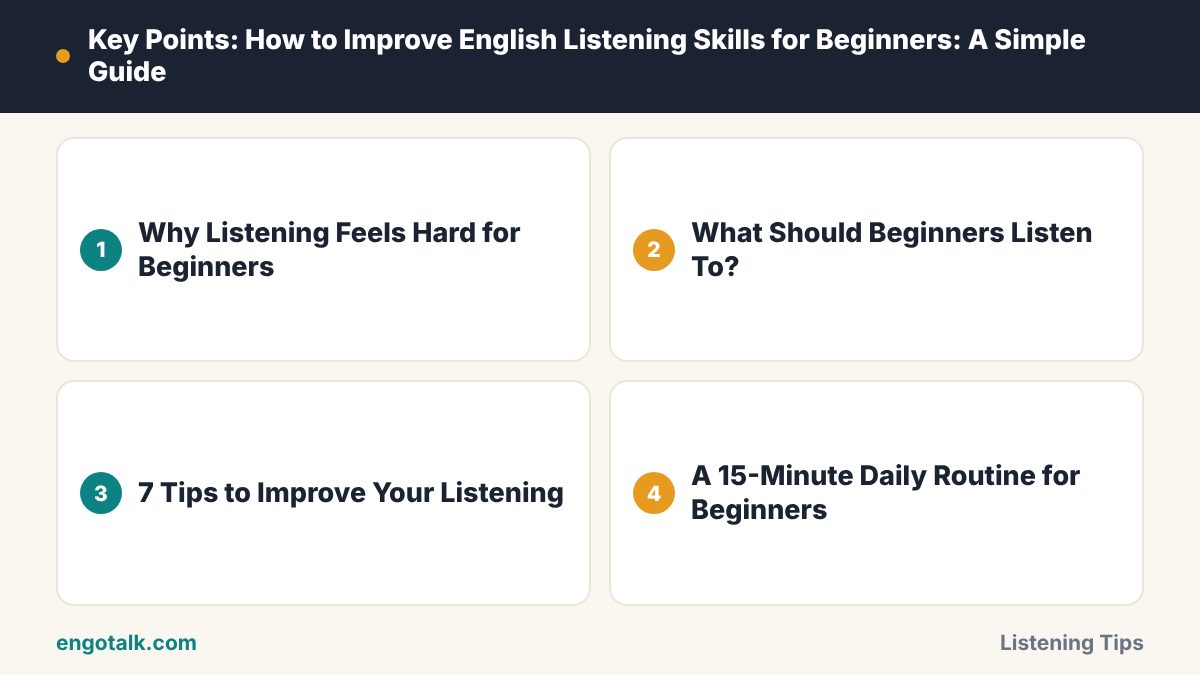
Why Listening Feels Hard for Beginners
Limited vocabulary: If you don't know a word, you can't hear it clearly.
Speed: Natural English is faster than the English in textbooks.
Sounds that don't exist in your native language: Sounds like "th", "v" and "z" are harder to recognise.
Connected speech: Native speakers link words together. Learn more in how to understand fast English speakers.
What Should Beginners Listen To?
Learner podcasts: Slow, clear speech with explanations. Start with our list of free English podcasts for beginners.
Graded audiobooks: Graded readers often come with audio. See English story books for beginners.
Children's cartoons: Shows like Peppa Pig and Bluey use simple, clear English.
Short YouTube lessons: Channels for English learners explain everyday phrases.
7 Tips to Improve Your Listening
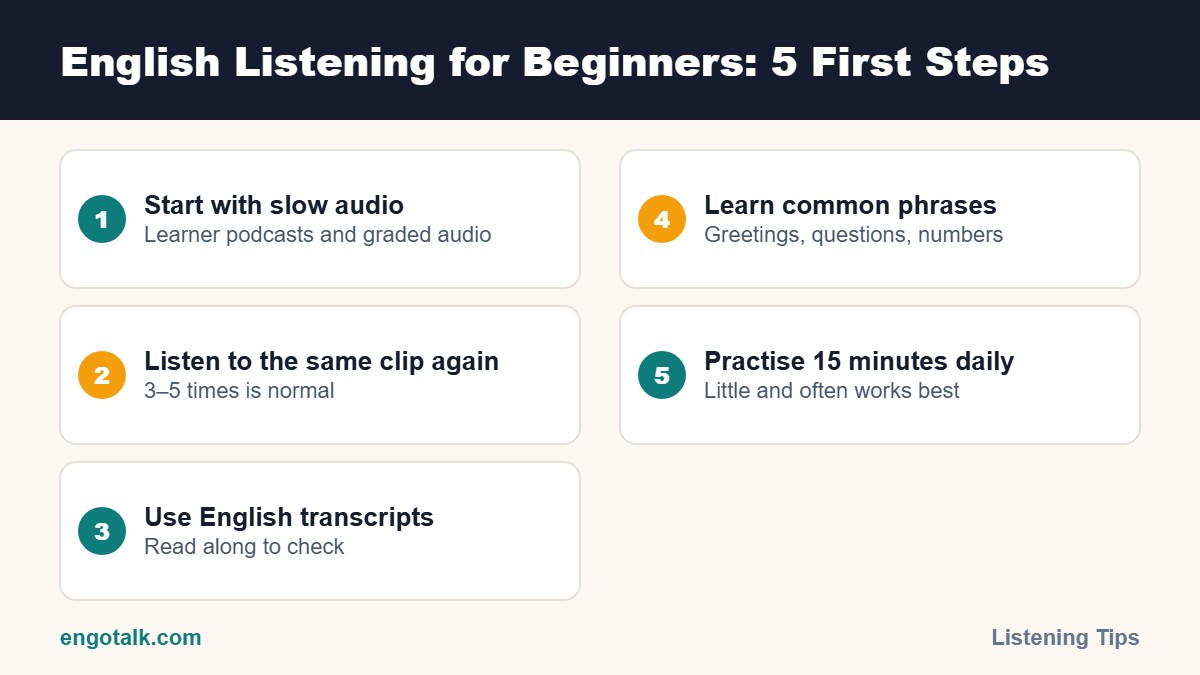
1. Listen to the same audio many times
Beginners often think they must listen to new material every day. In fact, listening to one short clip 3–5 times is much more effective. Each time, you will understand more.
2. Use transcripts
Listen first, then read the transcript, then listen again. You will see which words you missed and why.
3. Learn high-frequency phrases
Greetings, numbers, times, days and common questions ("How are you doing?", "What do you do?") appear everywhere. Knowing them makes conversations much easier to follow.
4. Don't try to understand every word
Focus on the main idea and key words. Even native speakers don't hear every word clearly.
5. Slow down the audio
Use 0.75x speed on YouTube or podcast apps at first, then return to normal speed.
6. Repeat out loud
Repeating sentences helps your brain remember sounds. When you are ready, try the shadowing technique.
7. Practise a little every day
15 minutes every day is better than two hours once a week. Your ear needs regular training.
A 15-Minute Daily Routine for Beginners
3 minutes: Listen to a short clip once without reading.
4 minutes: Listen again with the transcript.
3 minutes: Note 3–5 new words or phrases.
5 minutes: Listen again and repeat sentences out loud.
How to Stay Motivated
Choose topics you enjoy.
Track your progress: re-listen to an old clip after a month and notice how much more you understand.
Celebrate small wins, like understanding a whole scene without subtitles.
Practise with a partner so learning feels social, not lonely.
Ready for more? Read 7 easy ways to understand native speakers.
Start Real Listening Practice on EngoTalk
On EngoTalk, you can match with learners at your own level on live 1-on-1 video calls, so conversations are never too fast or too difficult. It is a safe, friendly place to start listening and speaking. Start practising today.
Frequently Asked Questions
Why can't I understand spoken English even though I can read it?
Reading and listening are different skills. Spoken English is faster and words link together, so your ear needs separate training.
How long does it take to improve listening?
With 15–20 minutes of daily practice, most beginners notice clear progress in four to eight weeks.
Should beginners watch movies?
Yes, but start with short scenes or simple shows, and use English subtitles.
Is it okay to use subtitles in your native language?
Only at the very beginning. Switch to English subtitles as soon as you can.
Test yourself: 5-question quiz
Check what you remember from this article. It takes about one minute, and you earn XP for completing it.