How to Understand Fast English Speakers: 8 Practical Tips
You can read English well. You understand your teacher. But when native speakers talk to each other, in a film, a podcast or a video call, it suddenly sounds like one long word. This is one of the most common frustrations for English learners, and it does not mean your English is bad.
Native speakers don't speak every word clearly. They link words, shorten them and stress only the important ones. Once you understand these patterns, fast English becomes much easier. In this guide, you will learn why fast English is hard to follow and 8 practical tips to understand it better.
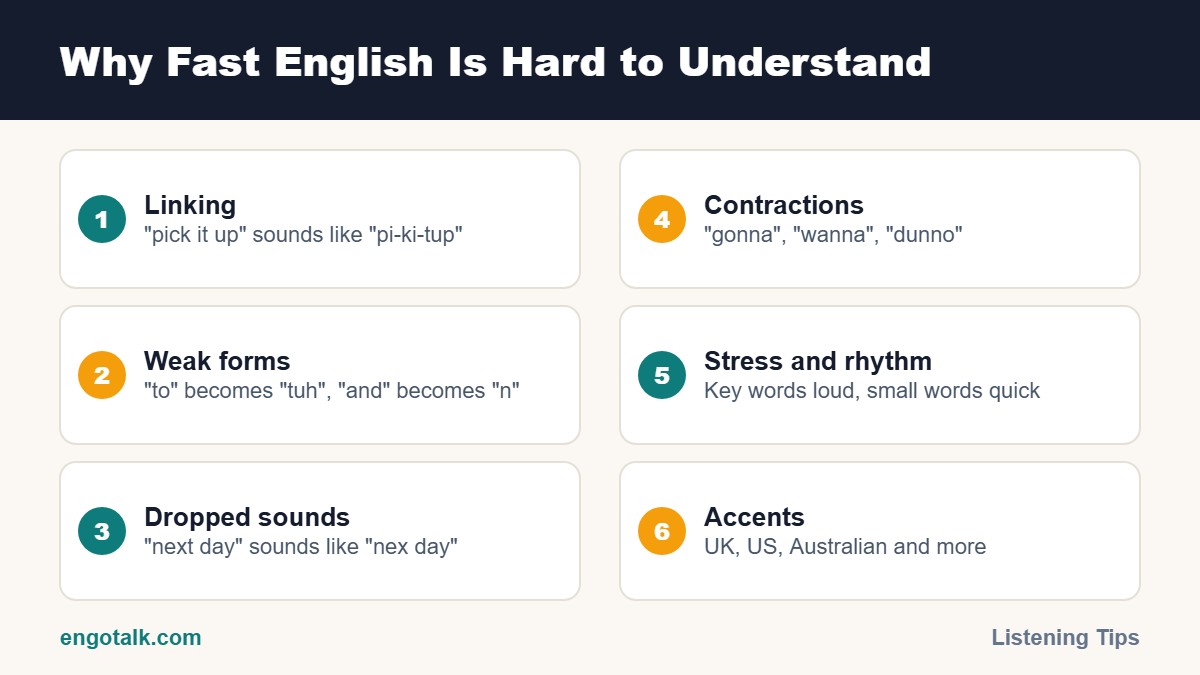
Why Fast English Sounds So Difficult
1. Linking
Words join together. "Pick it up" sounds like "pi-ki-tup". "Not at all" sounds like "no-ta-tall".
2. Weak forms
Small words become short and quiet. "To" sounds like "tuh", "and" sounds like "n", "can" sounds like "kn". "Fish and chips" becomes "fish n chips".
3. Dropped sounds
Some sounds disappear. "Next day" sounds like "nex day", and "Christmas" has no "t" sound.
4. Informal contractions
"Going to" becomes "gonna", "want to" becomes "wanna", "I don't know" becomes "dunno".
5. Stress and rhythm
English stresses important words (nouns, main verbs, adjectives) and says the small words very quickly. If you listen for every word equally, you will feel lost.
8 Tips to Understand Fast English Speakers
1. Listen for key words, not every word
Focus on the stressed words that carry meaning. In "I'm going to the shop to buy some milk", the key words are "going", "shop", "buy" and "milk". That is enough to understand.
2. Learn connected speech patterns
Learn common reductions like gonna, wanna, gotta, kinda, lemme and didja ("did you"). When you know them, you will recognise them immediately.
3. Use the shadowing technique
Repeating fast audio trains your ear and your mouth together. Follow our step-by-step shadowing guide.
4. Use transcripts and subtitles smartly
Listen first without text, then read the transcript to see what you missed, then listen again. This "listen–read–listen" cycle is very effective.
5. Slow it down, then speed it up
Use the playback speed setting on YouTube or podcast apps. Start at 0.75x, then return to normal speed once you understand.
6. Repeat the same audio
Listening to one short clip five times is better than listening to five different clips once. Each time, you will catch more.
7. Expose yourself to different accents
British, American, Australian and Indian accents all sound different. Listen to a variety. Our list of free English podcasts includes several accents.
8. Practise real conversations
In real conversations, you can ask people to repeat, and your brain learns to process English quickly under real pressure.
Useful Phrases When You Don't Understand
"Sorry, could you say that again?"
"Could you speak a little more slowly, please?"
"Sorry, did you say Monday or Sunday?"
"So you mean that...?"
Native speakers are usually happy to repeat. Asking is much better than pretending to understand.
A 2-Week Practice Plan
Days 1–3: Learn 10 common reductions (gonna, wanna, etc.).
Days 4–7: Listen to one 2-minute clip daily with the listen–read–listen method.
Days 8–11: Add 10 minutes of shadowing daily.
Days 12–14: Watch a TV scene without subtitles and have a real conversation in English.
For more ideas, see 7 easy ways to understand native speakers and how to learn English with movies and TV shows.
Train Your Ear in Live Conversations on EngoTalk
The fastest way to understand fast English is to have real conversations. On EngoTalk, you can talk with peer learners and tutors on live 1-on-1 video calls, at your own level. Start a conversation now.
Frequently Asked Questions
Why can I understand my teacher but not native speakers?
Teachers usually speak slowly and clearly. Native speakers use linking, weak forms and contractions in natural speech.
Should I watch videos at slower speed?
Yes, at first. Then gradually return to normal speed so your ear adapts.
How long does it take to understand fast English?
With daily practice, most learners notice a big improvement within one to two months.
Is it rude to ask someone to repeat?
No. Polite phrases like "Sorry, could you say that again?" are completely normal in English.
Test yourself: 5-question quiz
Check what you remember from this article. It takes about one minute, and you earn XP for completing it.