
IELTS Speaking Tips: How to Score Band 7+ in Part 1, 2 and 3
Want a higher IELTS Speaking score? You are not alone. Every year, thousands of students around the world get stuck at Band 5.5 or 6, even when their grammar is good. The reason is simple: IELTS Speaking is not a grammar test. It is a test of how well you communicate in real time.
In this guide, you will learn practical IELTS Speaking tips for Part 1, Part 2 and Part 3, how examiners actually score you, the most common mistakes to avoid, and a simple daily practice plan to help you reach Band 7 or higher.
How the IELTS Speaking Test Works
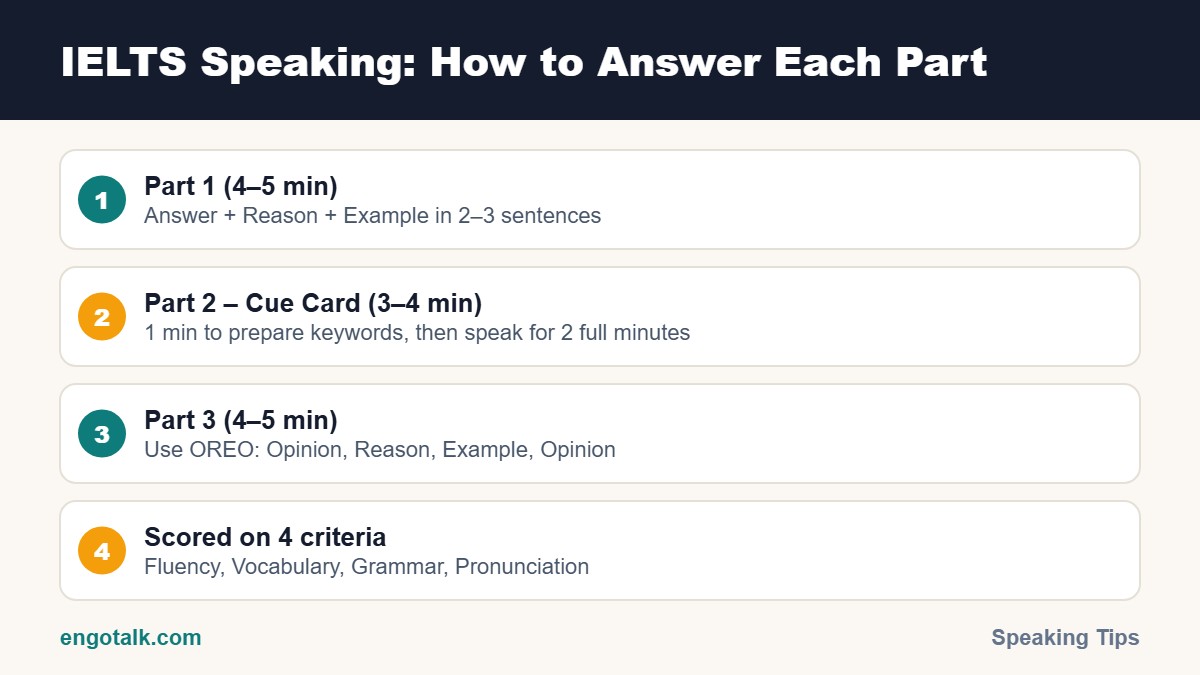
The IELTS Speaking test is a face-to-face conversation with an examiner. It lasts 11 to 14 minutes and has three parts:
Part 1 (4–5 minutes): Short questions about familiar topics like your home, studies, work, hobbies and daily routine.
Part 2 (3–4 minutes): You get a cue card, 1 minute to prepare, and then speak for 1–2 minutes on that topic.
Part 3 (4–5 minutes): A deeper discussion connected to the Part 2 topic. Questions are more abstract and ask for opinions and reasons.
How Examiners Score Your Speaking
Your band score comes from four criteria, each worth 25%:
Fluency and Coherence: Can you speak at length without long pauses, and are your ideas connected logically?
Lexical Resource: Do you use a good range of vocabulary, including some less common words and natural phrases?
Grammatical Range and Accuracy: Do you use a mix of simple and complex sentences with few errors?
Pronunciation: Are you easy to understand? Do you use stress and intonation naturally?
Notice that accent is not on this list. You do not need a British or American accent. You need to be clear.
IELTS Speaking Part 1 Tips
1. Give extended answers, not one-word replies
A "Yes" or "No" answer gives the examiner nothing to score. Aim for 2–3 sentences. Use the simple formula: Answer + Reason + Example.
Q: Do you like cooking?
A: Yes, I really enjoy it, especially on weekends. It helps me relax after a busy week, and I love cooking traditional dishes from my home country with my family.
2. Don't memorise answers
Examiners are trained to spot memorised answers. When they do, they may change the question or lower your score. Practise ideas, not scripts.
3. Be natural and relaxed
Part 1 is a warm-up. Smile, speak naturally and treat it like a friendly chat.
IELTS Speaking Part 2 Tips (Cue Card)
4. Use your 1-minute preparation wisely
Don't write full sentences. Write 5–6 keywords for each bullet point on the card. This keeps you on track without sounding like you are reading.
5. Follow a simple structure
Introduction: Say what you are going to talk about.
Bullet points: Cover each point on the card in order.
Feelings and reflection: End with why it was important or how you felt.
6. Keep talking until the examiner stops you
Try to speak for the full 2 minutes. If you run out of ideas, add a short story, describe details (colours, people, sounds) or explain how your feelings changed over time.
IELTS Speaking Part 3 Tips
7. Give opinions with reasons and examples
Part 3 is where Band 7+ students stand out. Use the OREO method: Opinion, Reason, Example, Opinion again.
Q: Do you think children should learn to cook at school?
A: I believe they should. Cooking is a basic life skill, and it also teaches responsibility and healthy eating. For example, many university students live away from home and depend on fast food because they never learned to cook. So, I think early training would really help them.
8. Talk about society, not just yourself
Part 3 questions are general. Use phrases like "Most people in my country...", "In the past... but nowadays..." and "In the future, I expect...".
9. It is okay to think out loud
Use natural fillers instead of silence: "That's an interesting question...", "Let me think about that for a second...", "I've never really thought about it, but...".
Vocabulary and Grammar Tips for Band 7+
Use collocations: "heavy traffic", "make a decision", "a tight schedule".
Add a few idioms naturally: "once in a blue moon", "it's not my cup of tea". Don't force them.
Paraphrase the question instead of repeating it word for word.
Mix tenses: past, present perfect, future and conditionals ("If I had more time, I would...").
Use complex sentences with "although", "which", "whereas" and "even though".
Common IELTS Speaking Mistakes to Avoid
Speaking too fast because of nervousness
Using big words incorrectly just to impress
Long silences while translating from your native language in your head
Giving very short answers in Part 3
Asking the examiner "Is my answer correct?"
If you often translate in your head, read our guide on how to stop translating and think directly in English.
A Simple 30-Day IELTS Speaking Practice Plan
Week 1: Answer 10 Part 1 questions daily and record yourself.
Week 2: Practise 2 cue cards a day with a 1-minute timer.
Week 3: Practise Part 3 questions using the OREO method.
Week 4: Take full mock tests with a real speaking partner.
The most important step is speaking with a real person. Recording yourself helps, but only live conversation trains you to think and reply quickly under pressure, exactly like in the exam.
Practise IELTS Speaking Live on EngoTalk
On EngoTalk, you can match with a peer learner on a live 1-on-1 video call in seconds, or book an experienced tutor for mock IELTS Speaking sessions. No downloads needed, and lessons are affordable. Start practising now or see our pricing.
Frequently Asked Questions
Can I get Band 7 in IELTS Speaking without a native accent?
Yes. Examiners score pronunciation on clarity, not accent. A clear accent from any country can score Band 7 or higher.
How long should my answers be in Part 1?
Usually 2–3 sentences, around 15–25 seconds per answer.
What if I don't know anything about a Part 3 topic?
Be honest and still give an answer. Say "I'm not an expert on this, but I think..." and explain a possible reason.
How can I practise IELTS Speaking every day?
Answer sample questions out loud, record yourself, and take at least 2–3 live practice sessions a week with a partner or tutor.
Test yourself: 5-question quiz
Check what you remember from this article. It takes about one minute, and you earn XP for completing it.