
How to Overcome the Fear of Speaking English: 10 Confidence Boosters
Your heart beats faster, your mind goes blank and the English words you know suddenly disappear. If this happens when you try to speak English, you are not alone. Fear of speaking is one of the biggest barriers for learners around the world, and it often has little to do with how much English you actually know.
The good news is that confidence can be built, step by step. In this guide, you will learn why speaking feels scary, 10 practical confidence boosters, and a simple plan to start speaking without fear.
Why Speaking English Feels Scary
Fear of mistakes: Many of us were corrected harshly at school, so mistakes feel embarrassing.
Fear of judgment: We worry that others will laugh at our accent or grammar.
Lack of practice: We studied English for years but rarely spoke it.
Perfectionism: We wait to be "perfect" before speaking, which never happens.
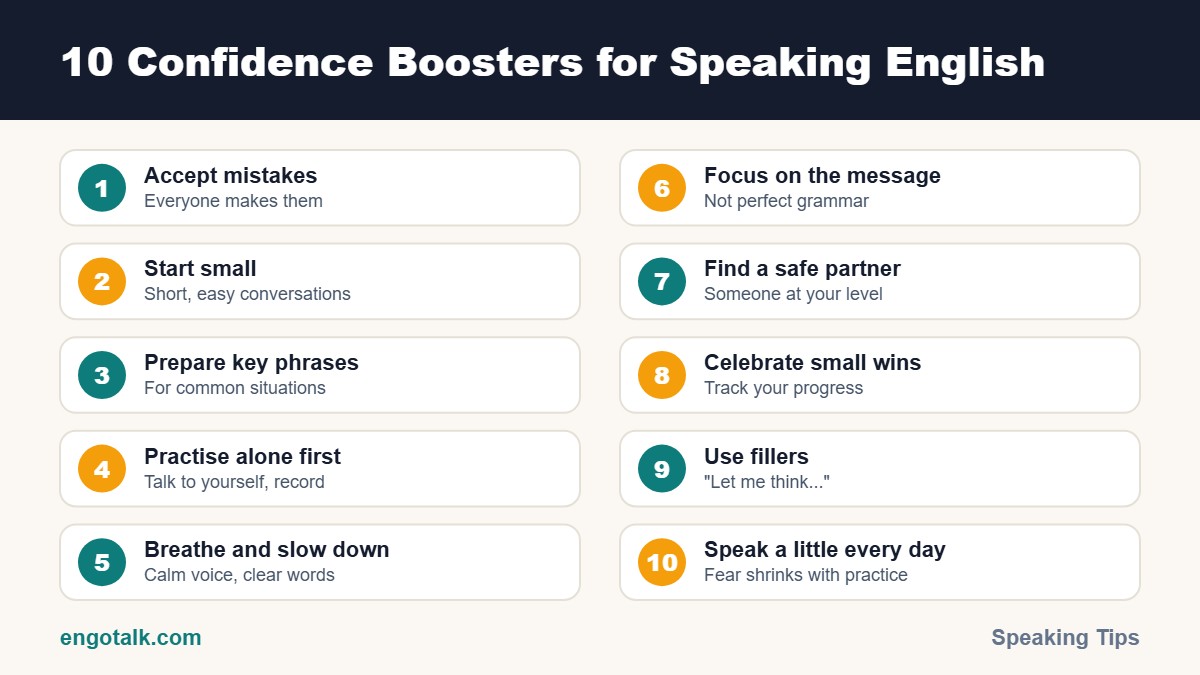
10 Confidence Boosters
1. Accept that mistakes are normal
Every English speaker makes mistakes, including native speakers. Mistakes are proof that you are learning, not proof that you are bad at English.
2. Start with small, easy conversations
Begin with simple topics like your day, food or hobbies. Small successes build confidence for harder conversations.
3. Prepare key phrases in advance
Prepare phrases for situations you often face: introducing yourself, asking for help, ordering food or answering common interview questions. Preparation reduces anxiety.
4. Practise alone first
Talk to yourself, describe your day out loud and record short answers. See 10 ways to practise English conversation without a partner.
5. Breathe and slow down
When you feel nervous, take a slow breath before speaking. Speaking slowly makes you sound calm and clear, not weak.
6. Focus on the message, not perfect grammar
The goal of speaking is communication. If the listener understands you, you have succeeded.
7. Find a safe practice partner
Practise with someone at your own level who is also learning. You will feel less pressure because you are both in the same situation.
8. Use "thinking" phrases
Instead of silence, use phrases like "Let me think...", "That's a good question" or "How can I say this...". They give you time and keep the conversation going.
9. Stop translating in your head
Translating makes you slow and nervous. Learn how to think directly in English.
10. Celebrate small wins
Did you speak for five minutes without stopping? Did you order coffee in English? Notice these wins. Confidence grows from evidence that you can do it.
A 2-Week Confidence Plan
Days 1–3: Talk to yourself for 5 minutes a day about your routine.
Days 4–7: Record a 1-minute answer to a simple question each day.
Days 8–10: Prepare and practise phrases for 3 real-life situations.
Days 11–14: Have at least two short conversations with a partner.
What to Do When You Freeze
Pause, smile and breathe.
Say "Sorry, let me try that again."
Use simpler words to say the same idea.
Ask the other person a question to give yourself time.
Pronunciation worries can also cause fear. Our pronunciation tips will help you speak more clearly, and our 10 daily habits for fluency will help you build a routine.
Build Confidence in a Friendly Space on EngoTalk
EngoTalk matches you with learners at your own level on live 1-on-1 video calls, so you can practise without pressure. When you are ready, you can also book a tutor. Start your first conversation today.
Frequently Asked Questions
Why do I get nervous when speaking English?
Usually because of fear of mistakes or judgment and lack of real speaking practice. Both improve with regular, low-pressure practice.
How can I speak English without fear?
Start with small conversations, practise alone first, prepare key phrases and practise regularly with a friendly partner.
Will people laugh at my accent?
Most people respect anyone speaking a second language. Clear pronunciation matters much more than accent.
How long does it take to become confident?
Many learners feel noticeably more confident after two to four weeks of regular speaking practice.
Test yourself: 5-question quiz
Check what you remember from this article. It takes about one minute, and you earn XP for completing it.