How to Improve English Pronunciation: 12 Practical Tips for Non-Native Speakers
Many English learners know a lot of English words and grammar rules, but they still feel shy when they speak. Often, the problem is not vocabulary. It is pronunciation. When people don't understand you the first time, your confidence drops.
The good news: you do not need a perfect British or American accent. Your goal is to be clear and easy to understand. In this guide, you will learn 12 practical tips to improve your English pronunciation, the most common sound problems for English learners, and simple daily exercises you can start today.
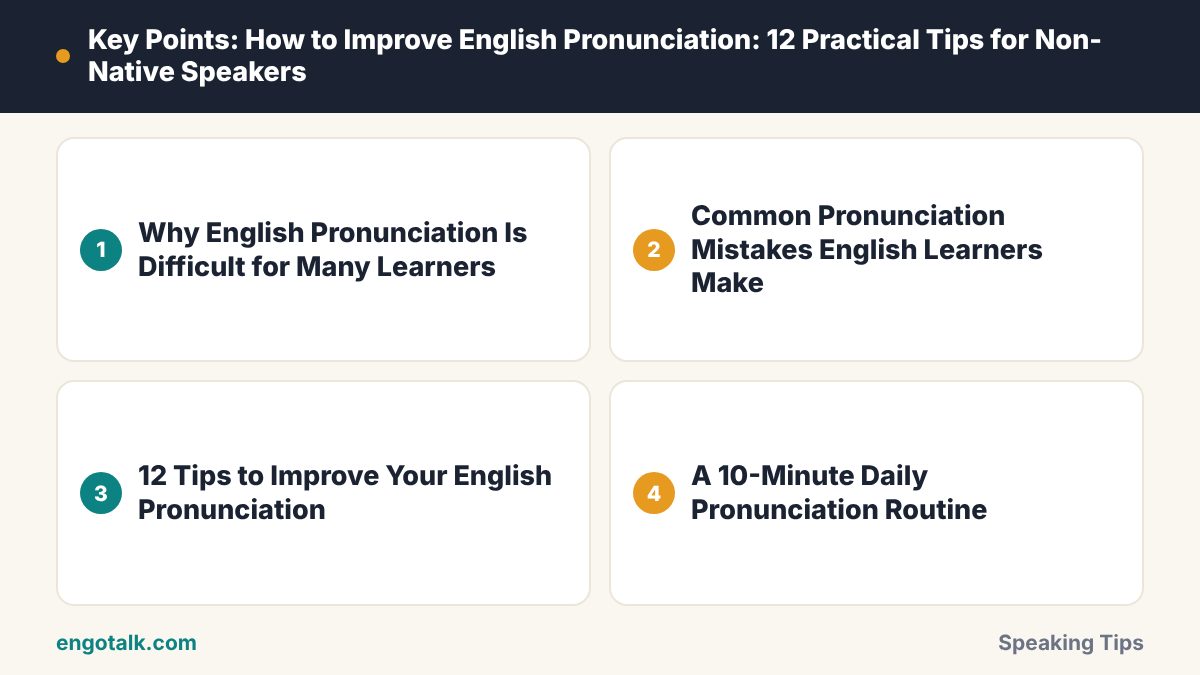
Why English Pronunciation Is Difficult for Many Learners
Your native language and English may use different sound systems. Some English sounds do not exist in your native language, and English spelling often does not match how words are spoken. For example, "though", "through" and "tough" look similar but sound completely different. That is why reading a word and saying it correctly are two different skills.
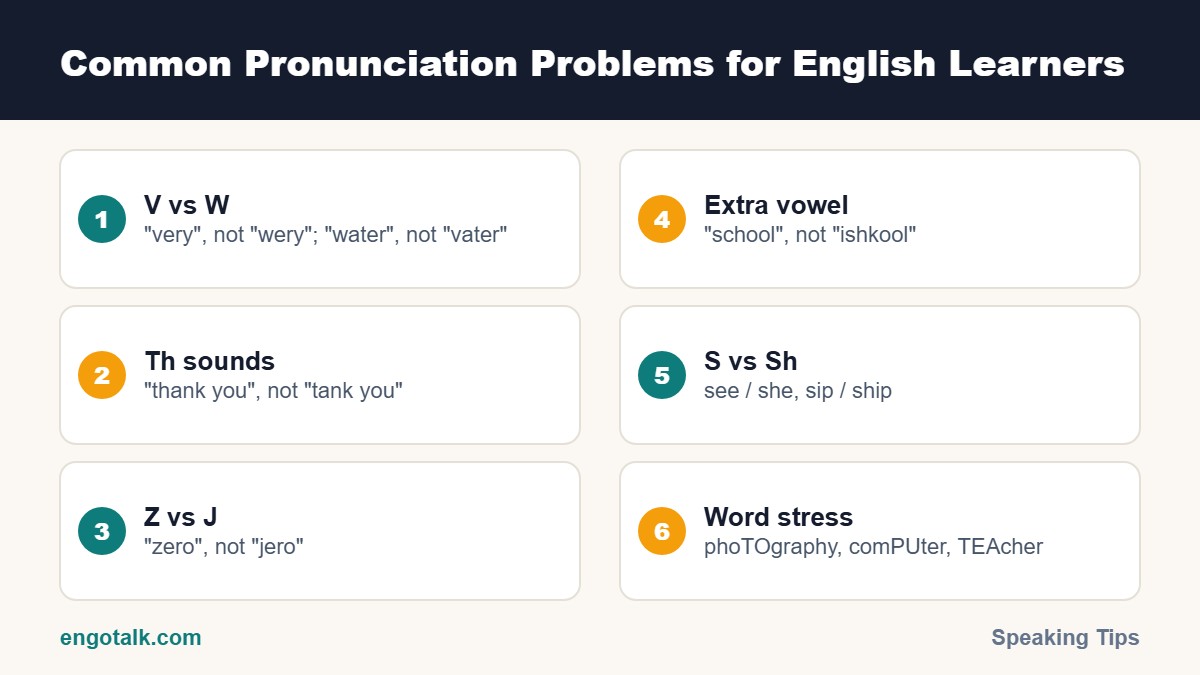
Common Pronunciation Mistakes English Learners Make
V and W confusion: Saying "wery" instead of "very", or "vater" instead of "water". For /v/, your top teeth touch your bottom lip. For /w/, your lips form a small circle.
Th sounds: Saying "tank you" for "thank you" or "dis" for "this". Put your tongue lightly between your teeth.
Z and J confusion: Saying "jero" instead of "zero". The /z/ sound buzzes like a bee.
Adding an extra vowel: Saying "ishkool" for "school" or "isteshon" for "station". English words can start with two consonants.
S and Sh: Mixing "see" and "she", or "sip" and "ship".
Wrong word stress: Saying "PHOtography" instead of "phoTOgraphy". Stress changes meaning and clarity.
F and P: Saying "pan" for "fan". For /f/, the top teeth touch the bottom lip and air flows out.
12 Tips to Improve Your English Pronunciation
1. Learn the sounds, not just the letters
English has about 44 sounds but only 26 letters. Learn the basic phonetic symbols (IPA) in a dictionary. It takes a week and helps for life.
2. Check every new word in a dictionary with audio
Use the Cambridge or Oxford online dictionary. Click the speaker icon and repeat the word 3–5 times out loud.
3. Focus on word stress
In English, one syllable in a word is louder and longer: TEAcher, comPUter, phoTOgraphy. Wrong stress confuses listeners more than a wrong sound.
4. Practise minimal pairs
Minimal pairs are words that differ by only one sound. Practise them slowly, then faster:
very / wary
thin / tin
ship / sip
fan / pan
rice / rise
5. Use the shadowing technique
Play a short audio clip and repeat it immediately, copying the speed, rhythm and intonation. Our step-by-step shadowing guide shows you exactly how.
6. Record yourself and compare
Record a short paragraph on your phone, then compare it with a native speaker's recording. You will notice mistakes you cannot hear while speaking.
7. Learn connected speech
Native speakers link words together. "What do you want to do?" often sounds like "Whaddaya wanna do?". Understanding this improves both your speaking and listening.
8. Slow down
Speaking fast does not mean speaking fluently. Slow, clear speech is easier to understand and sounds more confident.
9. Watch your mouth in a mirror
For sounds like /v/, /f/ and /th/, the position of your lips, teeth and tongue matters. A mirror helps you see what you are doing.
10. Practise tongue twisters
Try "Very well, very well, very well" or "Three free throws". Start slowly and speed up gradually.
11. Read aloud for 10 minutes every day
Reading aloud trains your mouth muscles. Choose a simple news article or story and read it out loud slowly and clearly.
12. Speak with real people regularly
You can practise alone, but real improvement happens in conversation. Speaking partners show you instantly when you are not understood, and that feedback is the fastest way to improve.
A 10-Minute Daily Pronunciation Routine
2 minutes: Minimal pairs for one problem sound.
3 minutes: Shadow a short audio clip.
3 minutes: Read a paragraph aloud and record it.
2 minutes: Listen back and note one thing to fix tomorrow.
Small daily practice beats one long session per week. Within a month, you will notice clearer speech.
Practise Your Pronunciation Live on EngoTalk
EngoTalk connects you with peer learners and tutors on live 1-on-1 video calls, right from your browser. Practise real conversations, get instant feedback and build confidence step by step. Start a practice session today.
Frequently Asked Questions
Do I need a British or American accent?
No. Clear pronunciation matters much more than accent. Many fluent speakers keep their natural accent.
How long does it take to improve pronunciation?
With 10–15 minutes of daily practice, most learners notice clear improvement in 4–6 weeks.
Which sound should I fix first?
Start with the sound that causes the most misunderstanding. For many learners, that is V/W or Th.
Can I improve pronunciation without a teacher?
Yes, using dictionaries, shadowing and recordings. But a speaking partner or tutor helps you improve much faster.
Test yourself: 5-question quiz
Check what you remember from this article. It takes about one minute, and you earn XP for completing it.