
How to Take Notes While Listening to English Lectures (University and IELTS)

Listening to a lecture in English while writing notes at the same time is one of the biggest challenges for international students. The speaker keeps talking, you are still writing the last point, and suddenly you have missed something important. The same skill is tested in exams like IELTS Listening and TOEFL.
The good news is that note-taking is a technique, not a talent. In this guide, you will learn how to prepare before a lecture, what to write and what to skip, useful abbreviations and symbols, how to recognise signpost language and two popular note-taking methods.
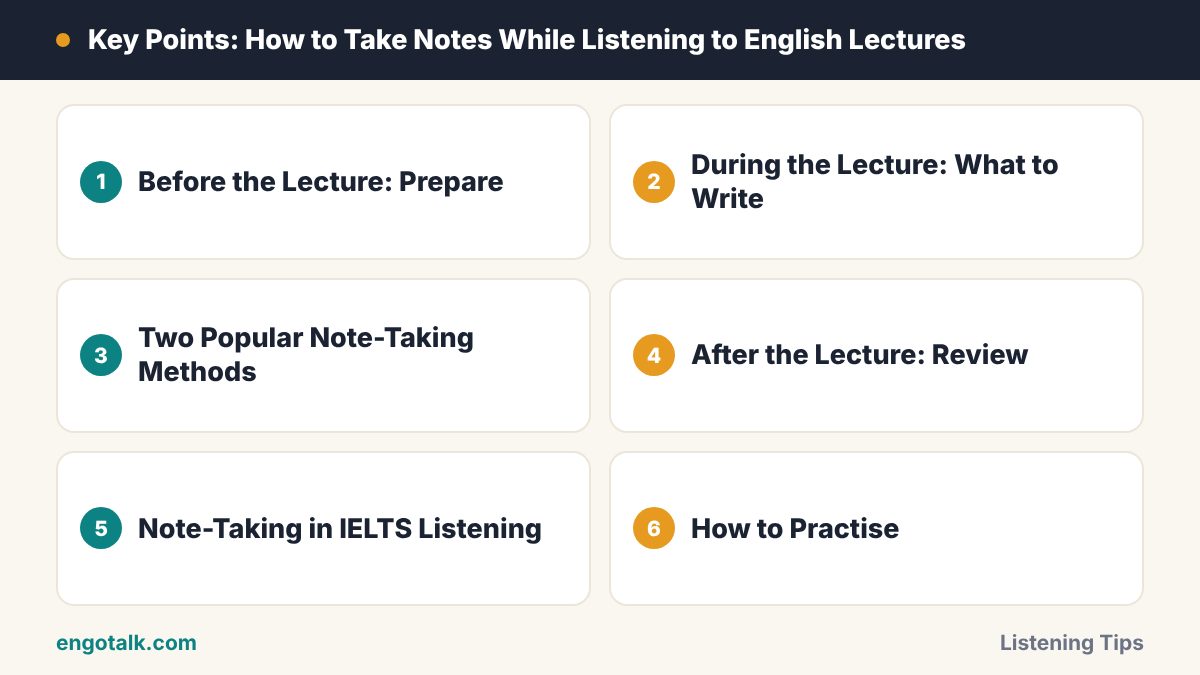
Before the Lecture: Prepare
Read about the topic in advance, even for 10 minutes.
Learn key vocabulary you expect to hear.
Look at the slides if they are available before class.
When you already know the context, your brain can focus on new information instead of struggling with every word.
During the Lecture: What to Write
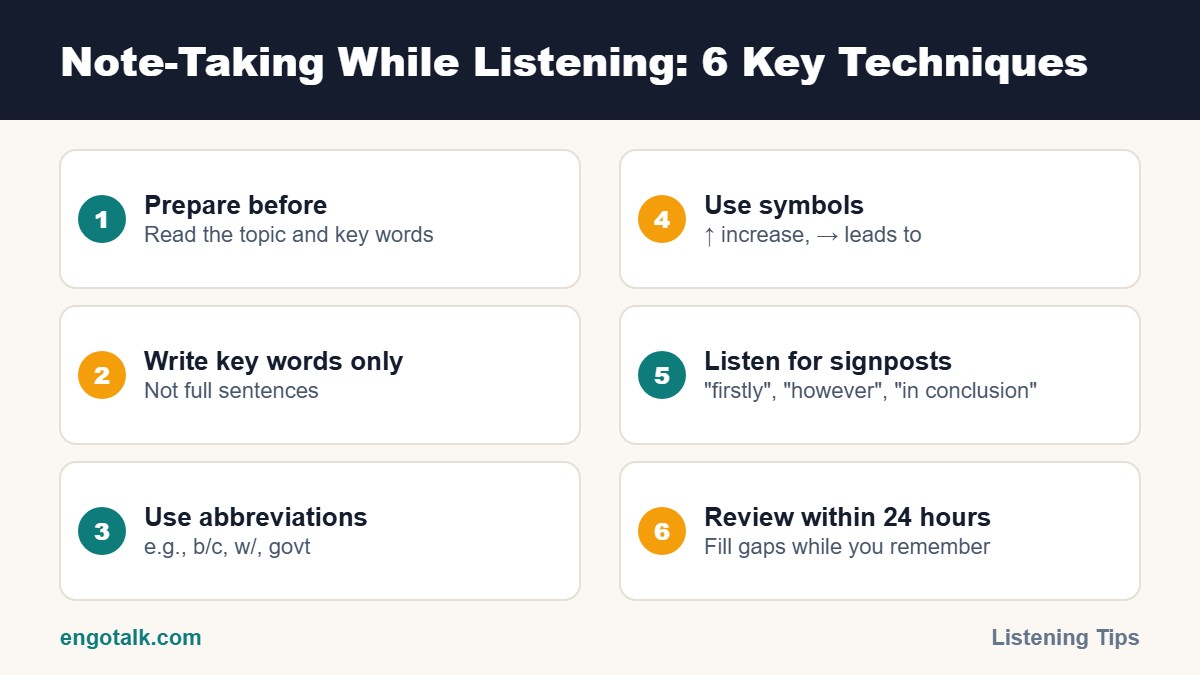
Write key words, not sentences
Write nouns, numbers, names and important verbs. Skip small words like "the", "is" and "of". For example, "The population of the city increased by 20% between 2010 and 2020" becomes: city pop. ↑ 20% 2010–20.
Use abbreviations
e.g. = for example
i.e. = that is
b/c = because
w/ = with; w/o = without
govt = government; info = information
approx. = approximately
Use symbols
↑ increase; ↓ decrease
→ leads to / causes
= equals / is the same as
≠ is different from
& or + = and
Listen for signpost language
Lecturers use signposts to show the structure of a talk. These words tell you what is coming next:
Sequence: "Firstly...", "Next...", "Finally..."
Important points: "The key point is...", "It's important to note..."
Contrast: "However...", "On the other hand..."
Examples: "For instance...", "Take ... as an example."
Summary: "To sum up...", "In conclusion..."
Two Popular Note-Taking Methods
The Cornell method
Divide your page into three parts: a large right column for notes, a narrow left column for key questions or words, and a box at the bottom for a short summary. After the lecture, use the left column to test yourself.
The outline method
Write main topics on the left, and indent sub-points underneath. It works well for clearly organised lectures.
After the Lecture: Review
Review your notes within 24 hours, while you still remember.
Fill in gaps and write full words for unclear abbreviations.
Write a 3–4 sentence summary in your own words.
Compare notes with a classmate.
Note-Taking in IELTS Listening
In IELTS, you write answers on the question paper as you listen. Use the same skills: predict the answer type, listen for signposts and write key words quickly. Read our IELTS Listening tips for more strategies.
How to Practise
Watch a short lecture or TED Talk and take notes using symbols and abbreviations.
Use a recording with a transcript and check what you missed.
Gradually increase the length, from 5 minutes to 20 minutes.
If lecturers speak too fast for you, see how to understand fast English speakers, and train your ear with the shadowing technique.
Discuss Lectures in English on EngoTalk
Explaining what you heard is the best way to check your understanding. On EngoTalk, you can summarise a lecture or talk to a partner or tutor on a live 1-on-1 video call. Start practising now.
Frequently Asked Questions
Should I write everything the lecturer says?
No. Write only key words, numbers, names and main ideas.
Is it better to take notes by hand or on a laptop?
Both work. Handwriting can help memory, while laptops are faster for some people. Choose what helps you review later.
Can I record lectures?
Some universities allow it. Always ask permission first, and still take notes to stay focused.
How can I improve my note-taking speed?
Practise regularly with short talks, using abbreviations and symbols until they become automatic.
Test yourself: 5-question quiz
Check what you remember from this article. It takes about one minute, and you earn XP for completing it.