
IELTS Listening Tips: 10 Proven Strategies to Score Band 8+
IELTS Listening is often called the "easiest" module to improve, yet many students lose easy marks because of small mistakes: a missed plural "s", a wrong spelling, or losing focus for just a few seconds. The good news is that Listening rewards strategy and practice more than talent.
In this guide, you will learn how the IELTS Listening test works, 10 proven strategies to score Band 8 or higher, common traps examiners set, and a practical study plan.
IELTS Listening Test Format
4 sections, 40 questions, about 30 minutes of audio.
Section 1: An everyday conversation (for example, booking a hotel or joining a club).
Section 2: A monologue in an everyday context (for example, a tour guide or a radio announcement).
Section 3: A conversation in an academic setting (for example, students discussing an assignment).
Section 4: An academic lecture.
You hear each recording only once. In the paper-based test, you get 10 minutes at the end to transfer answers. In the computer-delivered test, you get 2 minutes to check your answers.
IELTS Listening Band Score Guide
Your band depends on how many correct answers you get out of 40. Roughly:
30 correct ≈ Band 7
35 correct ≈ Band 8
39 correct ≈ Band 9
That means you can make only about 5 mistakes for a Band 8. Every mark matters.
10 Strategies to Score Band 8+ in IELTS Listening
1. Read the questions before the audio starts
Use every second of reading time. Look at the questions for the next section and predict what you will hear.
2. Underline keywords
Underline names, numbers, dates and key nouns in each question. These are the signals to listen for.
3. Predict the type of answer
Before the audio plays, ask: Is this a number, a name, a place, a plural noun or an adjective? Prediction helps your brain catch the right word.
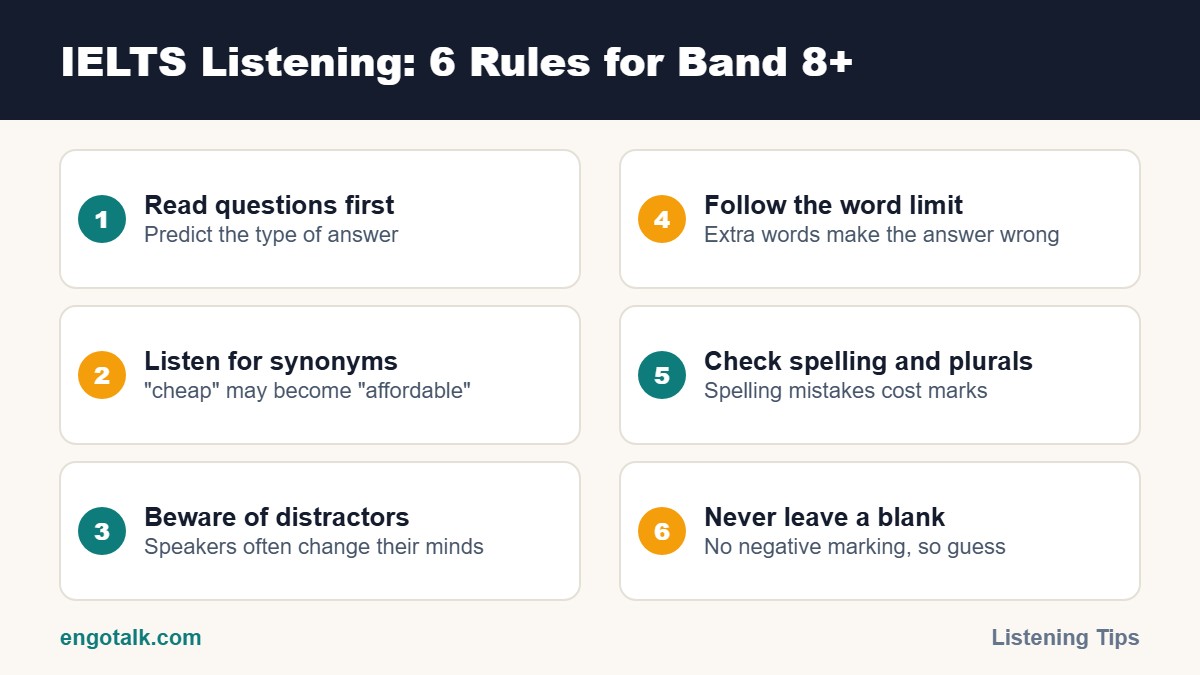
4. Listen for synonyms, not exact words
The question might say "cheap", but the speaker says "affordable" or "it won't cost much". IELTS tests whether you understand meaning, not just matching words.
5. Watch out for distractors
Speakers often change their minds: "The meeting is on Tuesday... oh no, sorry, it's been moved to Thursday." The first answer is often a trap. Wait for the final information.
6. Follow the word limit exactly
If the instruction says "NO MORE THAN TWO WORDS AND/OR A NUMBER", writing three words makes your answer wrong, even if the meaning is correct.
7. Check spelling and plurals
Spelling mistakes cost marks. Practise commonly tested words like "accommodation", "library", "Wednesday", "environment" and "necessary". Also check if the answer needs a plural.
8. Don't panic if you miss an answer
If you miss one, let it go and move to the next question. Staying stuck makes you miss two or three more. Guess at the end; there is no negative marking.
9. Get used to different accents
IELTS uses British, Australian, American, Canadian and other accents. Listen to a mix of podcasts, BBC and ABC Australia radio to train your ear. Our list of free English podcasts for learners is a great place to start.
10. Practise under real exam conditions
Use official Cambridge IELTS practice books. Do full tests in one sitting, play the audio only once and mark your answers strictly.
Common Question Types and Quick Tips
Form and note completion: Watch for spelling of names, addresses and numbers.
Multiple choice: All options are usually mentioned. Listen for which one is actually correct.
Map and plan labelling: Learn direction words: opposite, next to, on the left, at the end of, in the corner.
Matching: Read all options first and listen for paraphrased ideas.
A 4-Week IELTS Listening Study Plan
Week 1: Learn the test format and do 2 practice tests. Note your weak sections.
Week 2: Focus on Sections 1 and 2. Practise spelling, numbers and maps.
Week 3: Focus on Sections 3 and 4. Practise note-taking with lectures and podcasts.
Week 4: Do 4–5 full timed tests and review every mistake.
For general listening improvement outside the exam, try the shadowing technique. It trains your ear for natural speed and rhythm.
Improve Your Listening with Real Conversations
Practice tests are important, but real conversations train your brain to understand English at natural speed. On EngoTalk, you can join live 1-on-1 video calls with learners and tutors, improving both your listening and speaking at the same time. Start practising now.
Frequently Asked Questions
How many correct answers do I need for Band 7 in IELTS Listening?
Around 30 out of 40 for Band 7, and around 35 for Band 8.
Does spelling matter in IELTS Listening?
Yes. Incorrect spelling makes the answer wrong.
Can I write answers in capital letters?
Yes. Writing in all capitals is allowed and can make your handwriting clearer in the paper test.
What is the best way to practise IELTS Listening at home?
Use Cambridge IELTS books, listen to podcasts with different accents, and practise real conversations in English every week.
Test yourself: 5-question quiz
Check what you remember from this article. It takes about one minute, and you earn XP for completing it.