British vs American English Accents: Key Differences Learners Should Know
One day you watch an American series and understand most of it. The next day you listen to a British podcast and suddenly feel lost. If this sounds familiar, you are not alone. British and American English use the same language, but they can sound very different, especially for learners.
In this guide, you will learn the key pronunciation differences between British and American English accents, common vocabulary differences, how to train your ear for both and which accent you should learn.
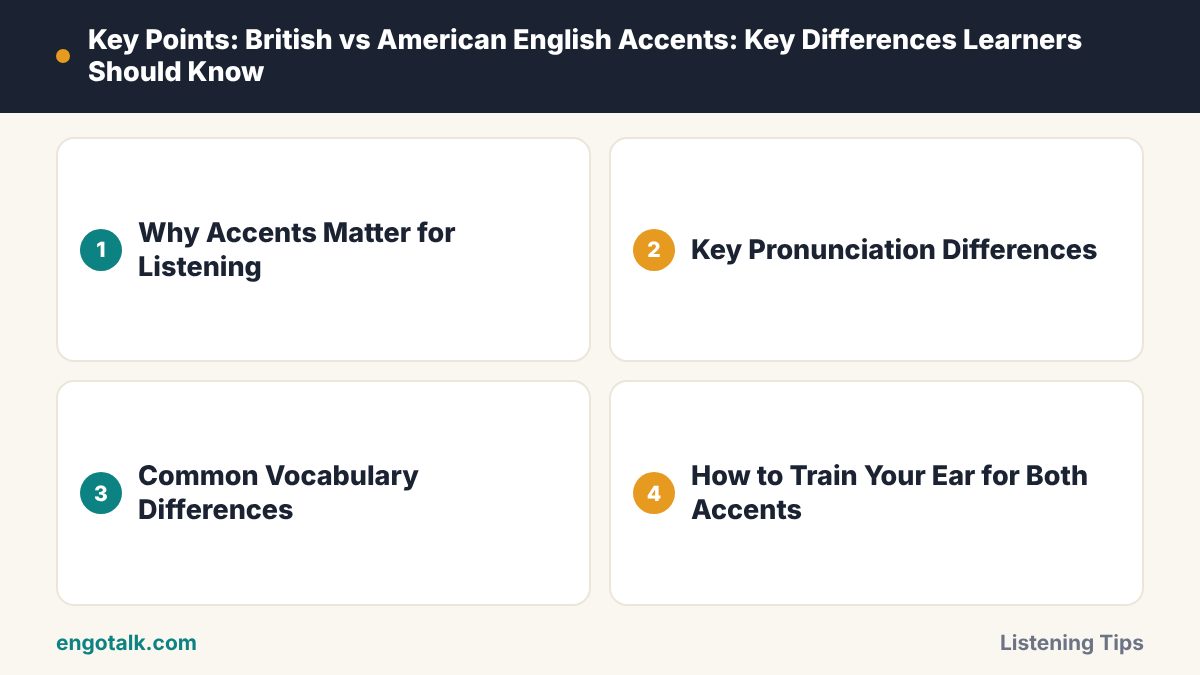
Why Accents Matter for Listening
Exams like IELTS and TOEFL, international workplaces and online content use many accents. If your ear only knows one accent, you may miss information. The goal is not to copy every accent, but to understand them all.
Note that "British" and "American" accents are not single accents. Each country has many regional accents. This guide focuses on the standard accents you hear most in media and learning materials.
Key Pronunciation Differences
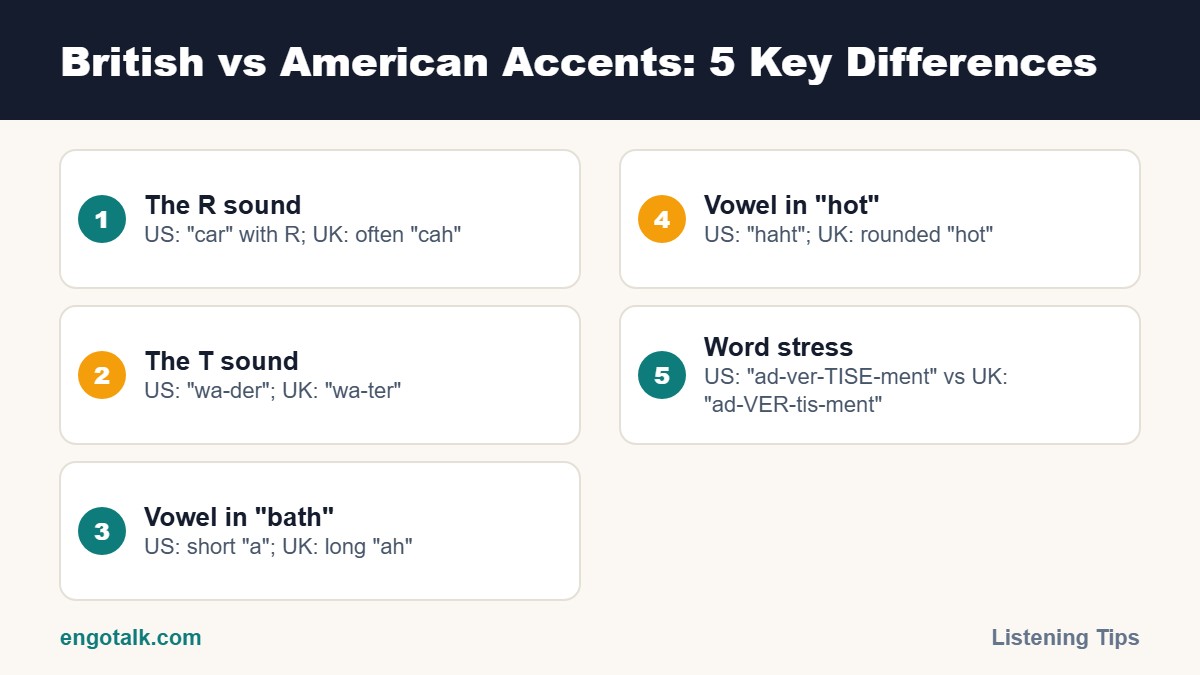
1. The "R" sound
American English usually pronounces the R after a vowel: "car", "water", "hard". Standard British English often drops it: "car" sounds like "cah".
2. The "T" sound
In American English, a T between vowels often sounds like a soft D: "water" sounds like "wader", "better" like "bedder". British English usually keeps a clear T.
3. The vowel in "bath", "can't" and "dance"
Americans use a short "a" (like "cat"). In standard British English, many of these words have a long "ah" sound: "bahth", "cahn't".
4. The vowel in "hot", "stop" and "job"
Americans often say a more open "ah" sound ("haht"), while British speakers use a short, rounded "o".
5. Word stress
Some words are stressed differently: "adVERtisement" (UK) vs "adverTISEment" (US), "GArage" (UK) vs "gaRAGE" (US).
Common Vocabulary Differences
flat (UK) – apartment (US)
lift (UK) – elevator (US)
holiday (UK) – vacation (US)
mobile (UK) – cell phone (US)
queue (UK) – line (US)
autumn (UK) – fall (US)
rubbish (UK) – trash/garbage (US)
How to Train Your Ear for Both Accents
Listen to both every week. For example, a British podcast and an American YouTube channel. See our list of free English podcasts.
Compare the same words. Use an online dictionary that offers both UK and US audio.
Watch films and series from both countries. Our guide to learning English with movies and TV shows shows you how.
Shadow each accent separately. Use the shadowing technique with short clips.
Add other accents later: Australian, Canadian, Irish, Indian and more.
Which Accent Should You Learn?
For speaking, choose the accent you hear most and feel comfortable with, but don't worry about sounding "perfectly" British or American. Clear pronunciation is far more important than accent. Mixing a few features is normal for international speakers. Read our pronunciation tips for practical exercises.
Practise with Speakers from Around the World on EngoTalk
On EngoTalk, you talk with learners and tutors from many countries on live 1-on-1 video calls, a great way to get used to different accents in real conversation. Start practising now.
Frequently Asked Questions
Is British or American English easier to understand?
It depends on what you hear most often. Many learners find American English easier at first because it is common in films and online videos.
Does IELTS use British or American accents?
IELTS Listening uses a range of accents, including British, American, Australian and others.
Should I choose one accent to speak?
You can, but clarity matters more than accent. It's fine to speak with your own natural accent.
How long does it take to understand different accents?
With regular listening practice, most learners notice a big improvement within a few months.
Test yourself: 5-question quiz
Check what you remember from this article. It takes about one minute, and you earn XP for completing it.