Formal vs Informal English: Key Differences with Examples
Have you ever written an email to a manager that sounded too casual, or sent a message to a friend that sounded like a business letter? Knowing the difference between formal and informal English is one of the most important skills for real-life communication. The grammar may be correct in both cases, but the wrong level of formality can make you sound rude, cold or strange.
This guide explains when to use formal and informal English, the key differences in vocabulary and grammar, and gives you plenty of side-by-side examples you can use straight away.
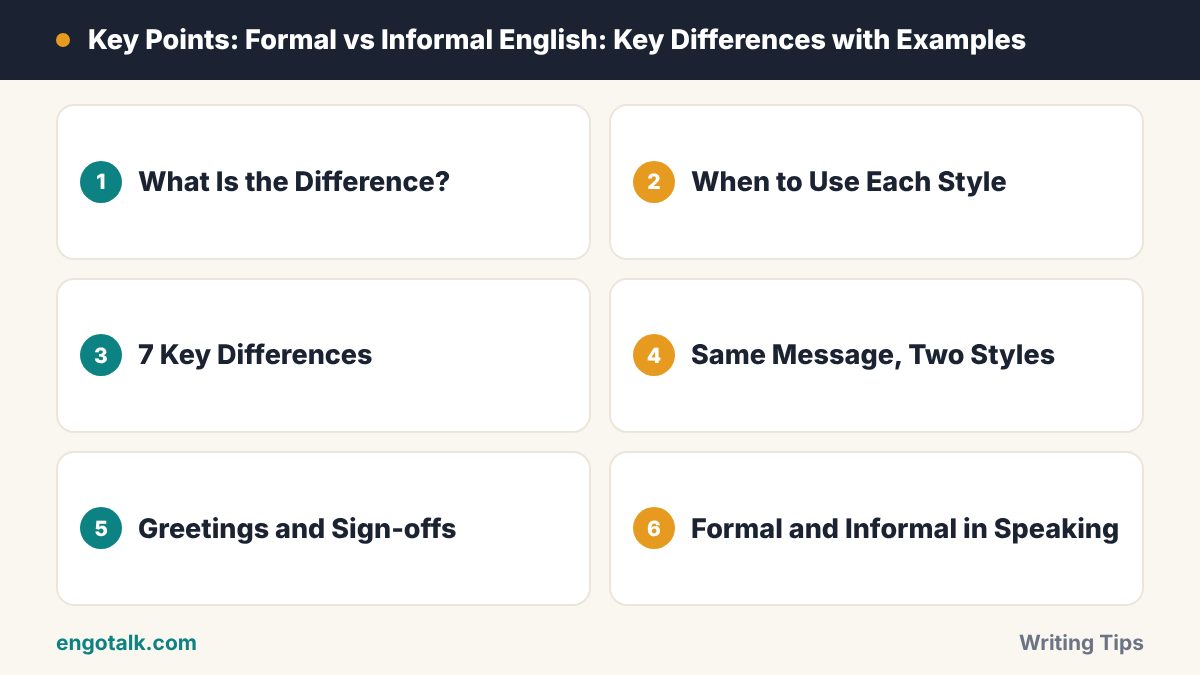
What Is the Difference?
Formal English is used in professional, academic and official situations. It sounds polite, careful and impersonal. Informal English is used with friends, family and people you know well. It sounds relaxed, friendly and personal.
There is also a large middle ground, often called neutral or semi-formal English, which works in most workplace emails and conversations with colleagues.
When to Use Each Style
Use formal English for:
Job applications, CVs and cover letters
Emails to people you don't know, clients or senior managers
Academic essays, reports and exams like IELTS Writing Task 2
Complaints, official requests and legal documents
Use informal English for:
Messages and chats with friends and family
Social media posts
Casual conversations and small talk
Emails to close colleagues you know well (often semi-formal)
7 Key Differences
1. Contractions
Informal English uses contractions; formal writing usually avoids them.
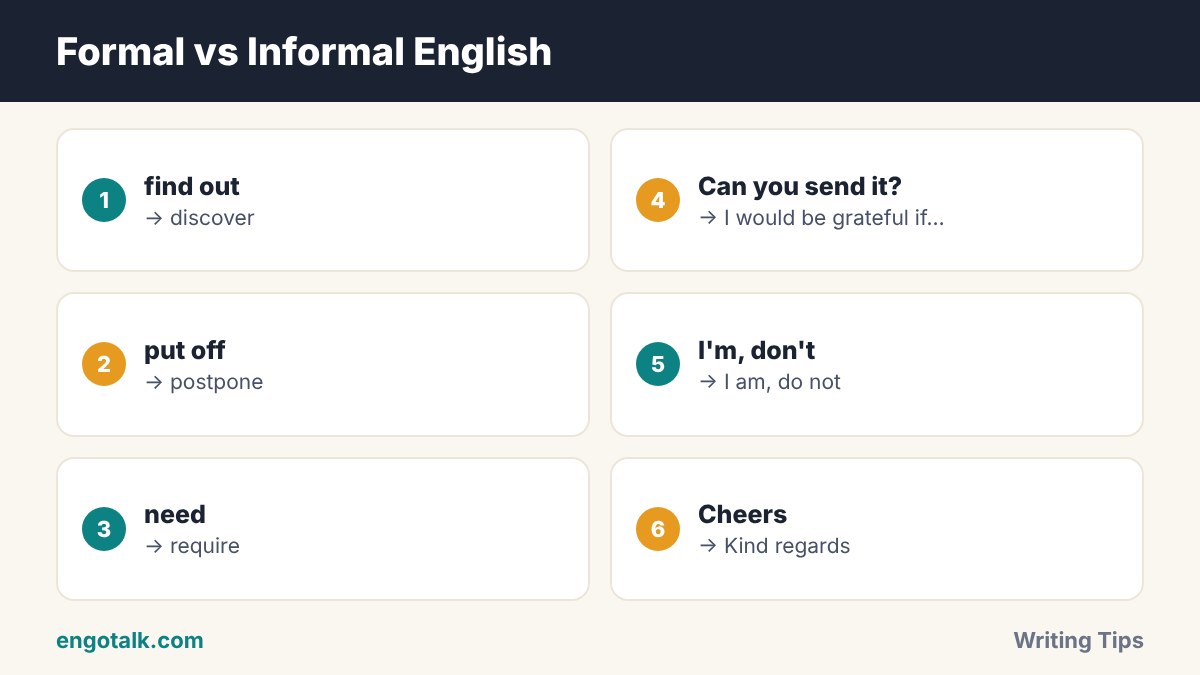
Informal: I'm, don't, can't, we'll
Formal: I am, do not, cannot, we will
2. Phrasal verbs vs single-word verbs
Phrasal verbs are common in informal English. Formal English often prefers a single, Latin-based verb.
find out → discover
put off → postpone
look into → investigate
get in touch → contact
go up → increase
3. Vocabulary choice
get → receive / obtain
need → require
help → assist
buy → purchase
ask for → request
a lot of → a significant number of / considerable
4. Sentence length and structure
Informal English uses short sentences and simple linking words like and, but and so. Formal English uses longer sentences and linkers such as however, therefore, furthermore and in addition.
5. Direct vs indirect requests
Informal: "Send me the file."
Neutral: "Could you send me the file?"
Formal: "I would be grateful if you could send me the file."
6. Personal vs impersonal language
Formal writing, especially academic writing, often uses the passive voice and impersonal structures: "It is widely believed that…" instead of "Lots of people think…".
7. Slang, abbreviations and emojis
Words like gonna, wanna, cool and stuff, abbreviations like BTW and ASAP, and emojis belong in informal messages only.
Same Message, Two Styles
Here is how the same situation sounds in each style.
Informal (to a friend):
Hey Sam! Sorry I can't make it on Friday, something's come up at work. Can we do next week instead? Let me know!Formal (to a client):
Dear Ms Taylor,
I regret to inform you that I am unable to attend our meeting on Friday due to an unexpected work commitment. Would it be possible to reschedule for next week? I apologise for any inconvenience.
Kind regards,
Daniel Lee
Greetings and Sign-offs
Formal greetings: Dear Sir or Madam, Dear Mr Smith, Dear Dr Patel
Neutral greetings: Dear Anna, Hello Anna
Informal greetings: Hi Anna, Hey!
Formal sign-offs: Yours faithfully (unknown name), Yours sincerely (known name), Kind regards
Informal sign-offs: Cheers, Speak soon, Take care, Love
For full templates, see our guide on how to write a professional email in English.
Formal and Informal in Speaking
Formality matters in speech too. In a job interview, say "Could you tell me more about the role?" rather than "So what's the job like?". With friends, "What's up?" is perfectly natural. A good rule: match the level of formality of the person you are talking to.
Common Mistakes
Being too informal with strangers: starting a job email with "Hey" or using "u" for "you".
Being too formal with friends: "I would be grateful if you could come to my party" sounds cold and funny.
Mixing styles: "Dear Sir, I wanna apply for the job." Keep one level of formality throughout.
Overusing big words: Formal doesn't mean complicated. Clear and polite is the goal.
Practice: Make It Formal
Rewrite these informal sentences in formal English.
I want to find out more about the course.
Sorry, but we can't help you with that.
Can you get back to me ASAP?
Suggested answers: 1. I would like to receive further information about the course. · 2. Unfortunately, we are unable to assist you with this matter. · 3. I would appreciate a reply at your earliest convenience.
Want more writing practice? Read how to improve your English writing skills.
Practise Switching Styles in Real Conversations
Choosing the right tone becomes automatic with practice. On EngoTalk, you can role-play a job interview in one call and chat casually in the next, with learners and tutors from around the world. Start a practice call now.
Frequently Asked Questions
What is the main difference between formal and informal English?
Formal English is polite, careful and impersonal, used in professional and academic contexts. Informal English is relaxed and personal, used with friends and family.
Are contractions allowed in formal writing?
In very formal writing, such as academic essays and official letters, it is best to avoid them. In most workplace emails, a few contractions are acceptable.
Should I use formal English in IELTS Writing?
Yes for Task 2 and Academic Task 1. In General Training Task 1, the level depends on who you are writing to: formal for a company, informal for a friend.
Is "Hi" too informal for a work email?
"Hi" is fine for colleagues and people you already know. For a first email to a client or a senior person, "Dear" is safer.
Test yourself: 5-question quiz
Check what you remember from this article. It takes about one minute, and you earn XP for completing it.