English Punctuation Rules: Commas, Apostrophes and More (With Examples)
Punctuation may look like a small detail, but it changes meaning and makes your writing easy (or hard) to read. Compare "Let's eat, Grandma!" with "Let's eat Grandma!" One comma makes the difference between a friendly invitation and a very strange sentence.
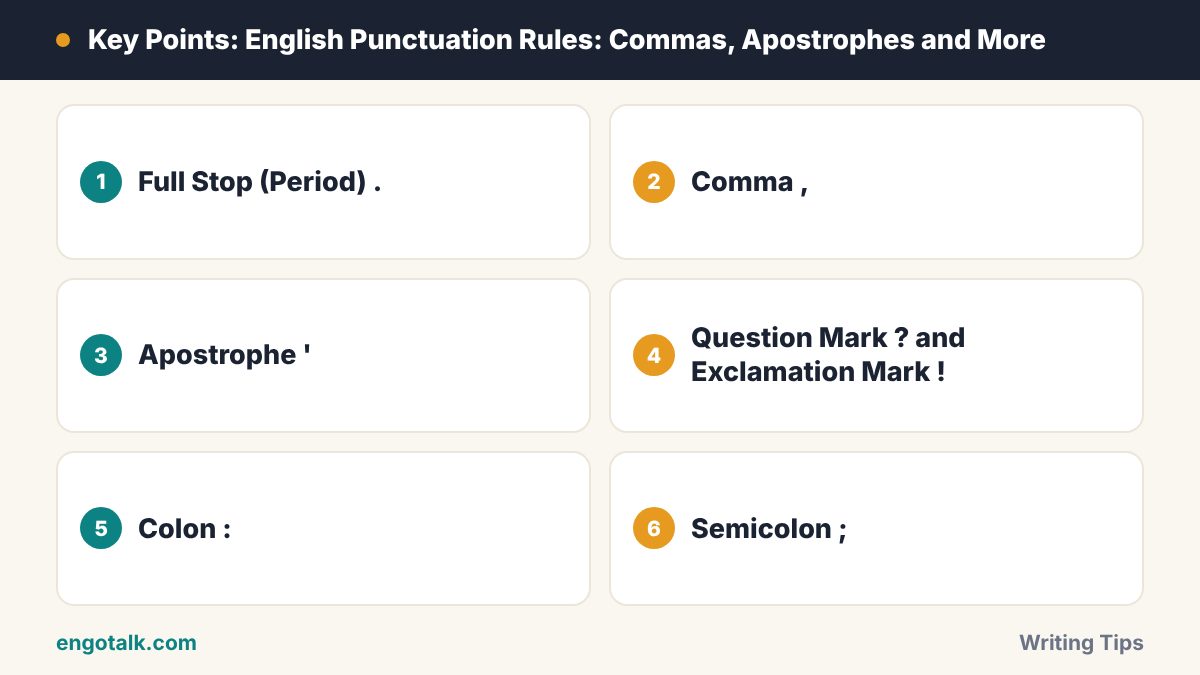
In this guide, you will learn the essential English punctuation rules with clear examples: full stops, commas, apostrophes, question marks, colons, semicolons, quotation marks and capital letters, plus the most common punctuation mistakes learners make.
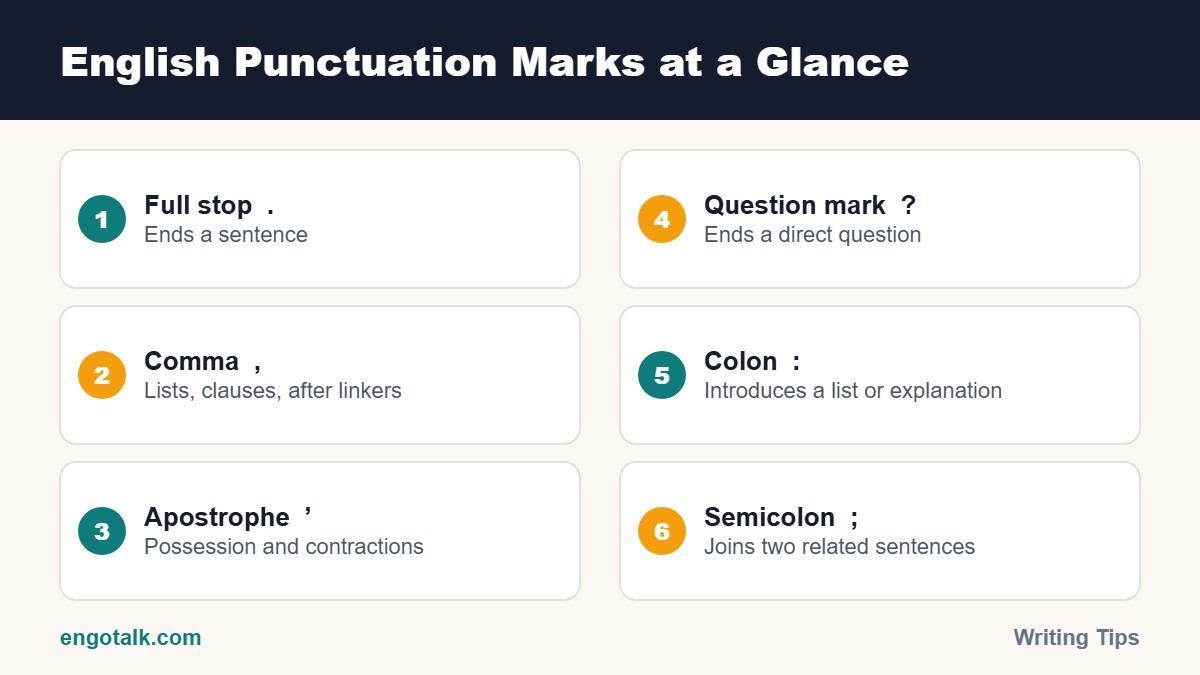
Full Stop (Period) .
Use a full stop at the end of a statement. In American English it is called a period.
I work in a hospital.
Abbreviations sometimes use full stops: e.g., etc., Dr. (in American English).
Comma ,
1. In lists
I bought apples, oranges and bananas. (Some writers add a comma before "and": "apples, oranges, and bananas". This is called the Oxford comma. Both styles are acceptable; be consistent.)
2. After introductory words and phrases
However, the meeting was cancelled. / In the morning, I go to the gym.
3. Before conjunctions joining two full sentences
I wanted to go, but I was too tired.
4. Around extra information
My brother, who lives in Toronto, is a doctor.
Common comma mistake: the comma splice
❌ I love reading, I read every day.
✅ I love reading. I read every day.
✅ I love reading, so I read every day.
Apostrophe '
1. Possession
Singular: the teacher's book
Plural ending in -s: the students' books
Irregular plural: the children's toys
2. Contractions
don't = do not, it's = it is, I'm = I am, they're = they are.
Common apostrophe mistakes
❌ The dog wagged it's tail. → ✅ its tail (possessive "its" has no apostrophe)
❌ Apple's for sale → ✅ Apples for sale (plurals don't need apostrophes)
❌ Their going home. → ✅ They're going home.
Question Mark ? and Exclamation Mark !
Use a question mark after direct questions: Where do you live?
Not after indirect questions: ❌ I asked where she lives? → ✅ I asked where she lives.
Use exclamation marks rarely in formal writing.
Colon :
Use a colon to introduce a list, an explanation or an example after a complete sentence.
You need three things: a passport, a ticket and a visa.
She had one goal: to pass the exam.
Semicolon ;
Use a semicolon to join two closely related complete sentences without a conjunction.
I have a big exam tomorrow; I need to study tonight.
Quotation Marks " "
Use them for direct speech and quotations: She said, "I'll be late." British English often uses single quotation marks ('...'), while American English uses double ("...").
Capital Letters
At the start of a sentence
For names, places, nationalities and languages: Maria, Paris, Japanese
For days and months: Monday, March
For the pronoun "I"
Quick Checklist
Does every sentence end with the right mark?
Did I avoid joining two sentences with only a comma?
Are apostrophes used only for possession and contractions?
Are names, days and "I" capitalised?
Good punctuation is part of clear paragraphs and essays. Read how to write a paragraph in English and common grammar mistakes learners make.
Improve Your English with EngoTalk
Strong writing and confident speaking go together. On EngoTalk, you can practise English with tutors and learners on live 1-on-1 video calls. Start practising today.
Frequently Asked Questions
When should I use a comma before "and"?
Use one before "and" when it joins two complete sentences. In lists it is optional (the Oxford comma); just be consistent.
What is the difference between "its" and "it's"?
"It's" means "it is" or "it has". "Its" shows possession: "The company changed its logo."
When do I use a semicolon?
Use it to join two closely related complete sentences without "and", "but" or "so".
Is punctuation different in British and American English?
Mostly the same. The main differences are quotation mark style and some abbreviations.
Test yourself: 5-question quiz
Check what you remember from this article. It takes about one minute, and you earn XP for completing it.