How to Give Your Opinion in English: 30 Phrases for Agreeing and Disagreeing
In meetings, classes, interviews and everyday conversations, people constantly ask, "What do you think?" Giving your opinion in English, and politely agreeing or disagreeing with someone else's, is one of the most useful speaking skills you can learn. Yet many learners either stay silent or use the same two phrases every time: "I think" and "I don't agree."
This guide gives you 30 natural phrases for giving opinions, agreeing, partly agreeing and disagreeing politely. You will also see when to use formal or informal phrases, a full example conversation, and the most common mistakes to avoid.
Why Learning Opinion Phrases Matters
When you share an opinion, you are not only giving information. You are also managing the relationship with the other person. A sentence like "You're wrong" can sound rude in English, even if your grammar is perfect, while "I see what you mean, but I'm not sure that's right" keeps the conversation friendly.
Good opinion phrases help you to:
Sound more fluent and confident in discussions.
Disagree without offending colleagues, teachers or friends.
Score higher in speaking exams like IELTS, where examiners listen for a range of language.
Give yourself a few seconds to think before you answer.
Phrases for Giving Your Opinion
Use these to introduce what you think. The first group is neutral and works almost everywhere.
Neutral and everyday
I think… – "I think online classes are more flexible."
In my opinion, … – "In my opinion, the price is too high."
Personally, I feel… – "Personally, I feel we need more time."
The way I see it, … – "The way I see it, both options have benefits."
If you ask me, … (informal) – "If you ask me, the film was too long."
I'd say that… – "I'd say that the second plan is safer."
More formal or academic
From my point of view, …
It seems to me that…
I would argue that…
As far as I'm concerned, …
Tip: Avoid starting every sentence with "I think." Rotating two or three of these phrases makes you sound much more natural.
Phrases for Agreeing
Agreeing is easy, but the strength of your phrase matters. Choose one that matches how much you really agree.
Strong agreement
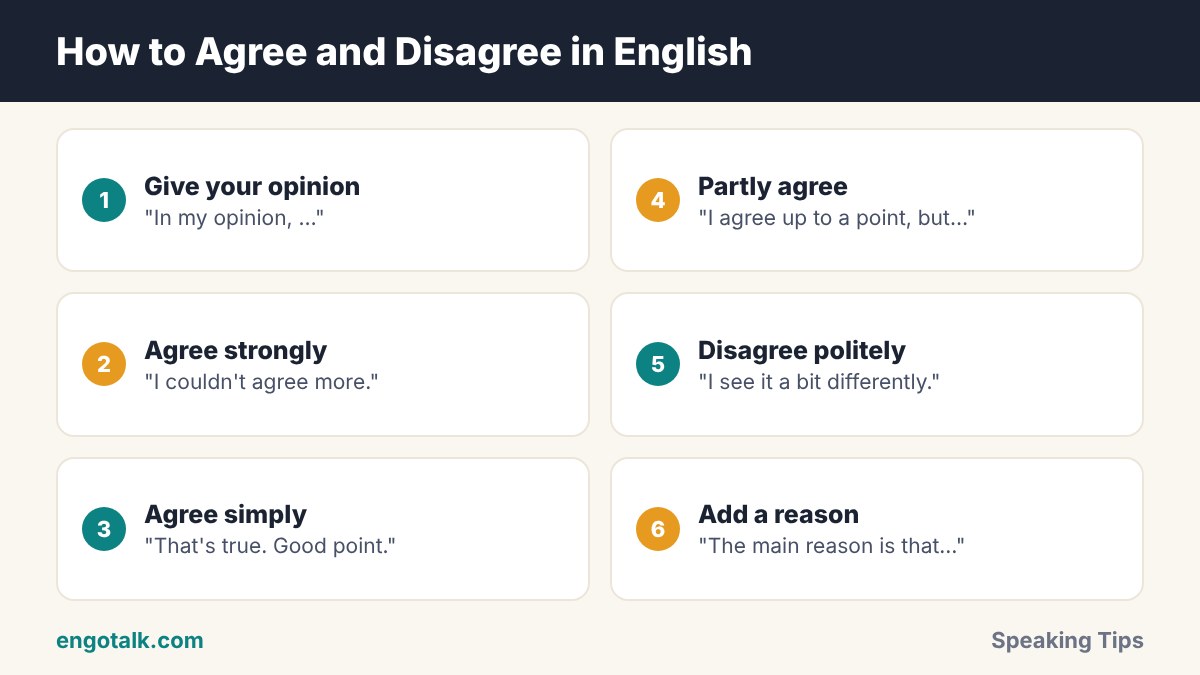
I completely agree.
Absolutely. / Exactly.
That's exactly what I think.
You're absolutely right.
I couldn't agree more. (This means you agree 100%, not that you disagree.)
Simple or casual agreement
I agree with you.
That's true. / Good point.
I think so too.
Phrases for Partly Agreeing
In real discussions, people rarely agree with everything. These phrases let you accept part of an idea and add your own view. They are extremely useful at work.
I agree up to a point, but…
That's partly true, but…
I see what you mean, but…
You have a point, although…
That may be true, but have you considered…?
Phrases for Disagreeing Politely
Native speakers often "soften" disagreement so it doesn't sound aggressive. Notice how many of these phrases start with something positive or use words like not sure and quite.
I'm not sure I agree.
I see it a bit differently.
I'm afraid I don't agree.
I take your point, but I think…
I'm not convinced that…
With respect, I think… (formal)
I don't think that's quite right.
Stronger disagreement (use carefully)
"I totally disagree" and "That's not true at all" are correct, but they sound direct. Use them with friends or when you feel strongly, not with your manager in a first meeting.
How to Give Reasons and Examples
An opinion without a reason sounds weak. After your opinion phrase, add a reason with because, since or the main reason is…, and then an example with for example or for instance.
Opinion: In my opinion, working from home is better for most office jobs.
Reason: The main reason is that people save time on commuting.
Example: For example, my sister saves almost two hours a day, and she uses that time to exercise.
This simple "opinion + reason + example" pattern works in conversations, job interviews and the IELTS Speaking test. If you are preparing for IELTS, read our guide on how to score Band 7 in IELTS Speaking.
Example Conversation: Agreeing and Disagreeing
Two colleagues, Sara and Leo, are discussing whether their team should move meetings online.
Sara: I think we should hold all our weekly meetings online from next month.
Leo: I see what you mean, but I'm not sure that's the best idea for every meeting.
Sara: Why not? The main reason I suggest it is that half the team works remotely.
Leo: That's true. I agree up to a point, but brainstorming sessions work better face to face.
Sara: Good point. So maybe weekly updates online, and brainstorming in the office?
Leo: I couldn't agree more. That sounds like a fair compromise.
Notice how Leo never says "You're wrong." He accepts part of Sara's idea and then gives his reason. That is the secret of polite disagreement in English. For more workplace language, see our list of English phrases for online meetings.
Common Mistakes to Avoid
"I am agree." ❌ – Agree is a verb, so say "I agree." ✅
"I am not agree." ❌ – Say "I don't agree" or "I disagree." ✅
"According to me…" ❌ – This sounds unnatural to most native speakers. Say "In my opinion…" ✅
"I agree with this point of view of you." ❌ – Say "I agree with your point of view." ✅
Using only "yes" or "no". Always add a short reason, even in casual chats.
Want to check whether you still make other common mistakes? Try our free Common English Mistakes Quiz.
Formal vs Informal: Which Phrase Should You Use?
With friends: "If you ask me…", "Totally!", "No way, I don't think so."
At work: "I see what you mean, but…", "I'd say that…", "Good point."
In essays, presentations and exams: "From my point of view…", "I would argue that…", "I'm not convinced that…"
How to Practise These Phrases
Choose five phrases from this list: two for opinions, one for agreeing, one for partly agreeing and one for disagreeing.
Answer a discussion question out loud, for example "Is social media good for teenagers?" Use the opinion + reason + example pattern.
Argue the opposite side. This trains you to disagree politely with your own idea.
Practise with a real person. Phrases only become natural when you use them in a live conversation.
You can find hundreds of discussion questions on our English conversation topics page, sorted by level.
Practise Giving Opinions on EngoTalk
Reading phrases is the first step; using them is what builds fluency. On EngoTalk, you can join a 1-on-1 video call with another English learner or a tutor and discuss real topics in minutes. Pick a question, share your opinion and practise agreeing and disagreeing politely. Start a practice call now.
Frequently Asked Questions
How do you politely disagree in English?
Start with something positive or neutral, then give your view. For example: "I see what you mean, but I think…" or "I'm not sure I agree, because…". Avoid "You're wrong."
What does "I couldn't agree more" mean?
It means you agree completely. Although it contains "couldn't," it is a very strong form of agreement.
Is "according to me" correct English?
It is understandable, but native speakers rarely use it to give their own opinion. "In my opinion" or "Personally, I think" sound more natural.
How can I give my opinion in the IELTS Speaking test?
Use a range of phrases such as "From my point of view" and "I'd argue that", and always support your opinion with a reason and an example.
Test yourself: 5-question quiz
Check what you remember from this article. It takes about one minute, and you earn XP for completing it.