
How to Guess the Meaning of Unknown Words from Context
When you read in English, you will always meet words you don't know. If you stop to look up every one, reading becomes slow and frustrating, and you quickly lose the meaning of the whole text. Strong readers, including native speakers, do something different: they guess the meaning from context.
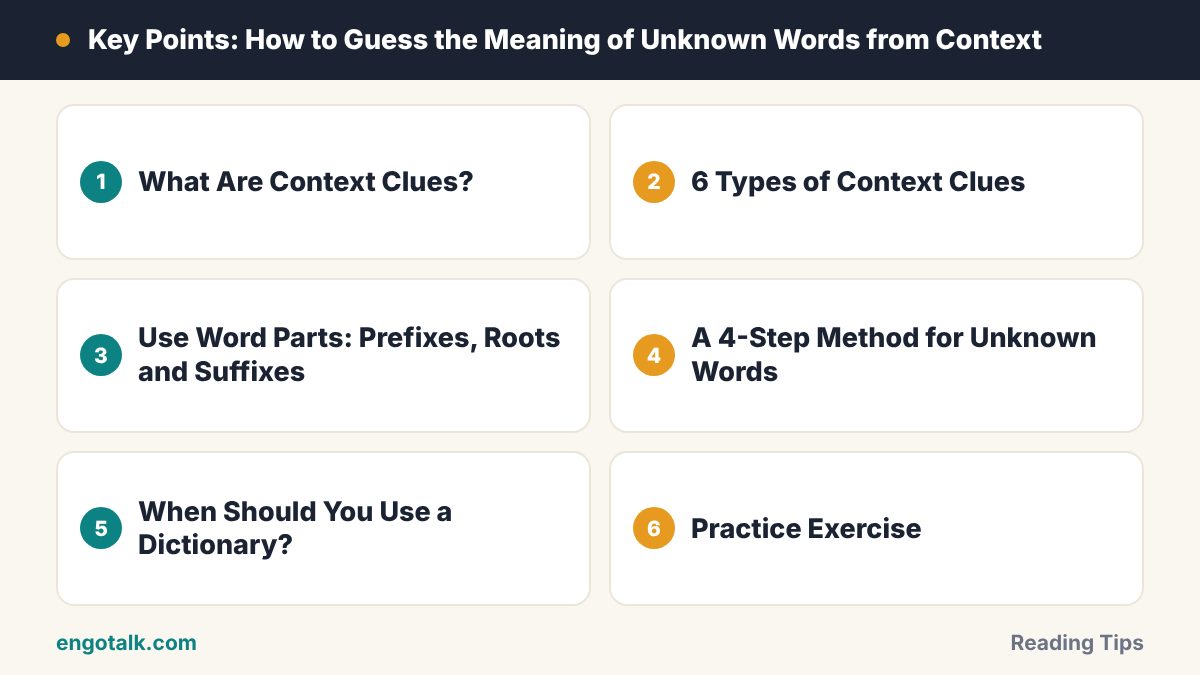
In this guide, you will learn six practical context clue strategies, how to use word parts to unlock meaning, when you should and shouldn't use a dictionary, and a short practice exercise with answers.
What Are Context Clues?
Context clues are hints in the sentence or paragraph around an unknown word that help you work out what it means. The writer often explains, gives an example, or contrasts the word with something you already know. You just need to know where to look.
Guessing from context has three big benefits:
You read faster and keep the flow of the text.
You remember words better because you worked out the meaning yourself.
You do better in exams like IELTS Reading, where you cannot use a dictionary.
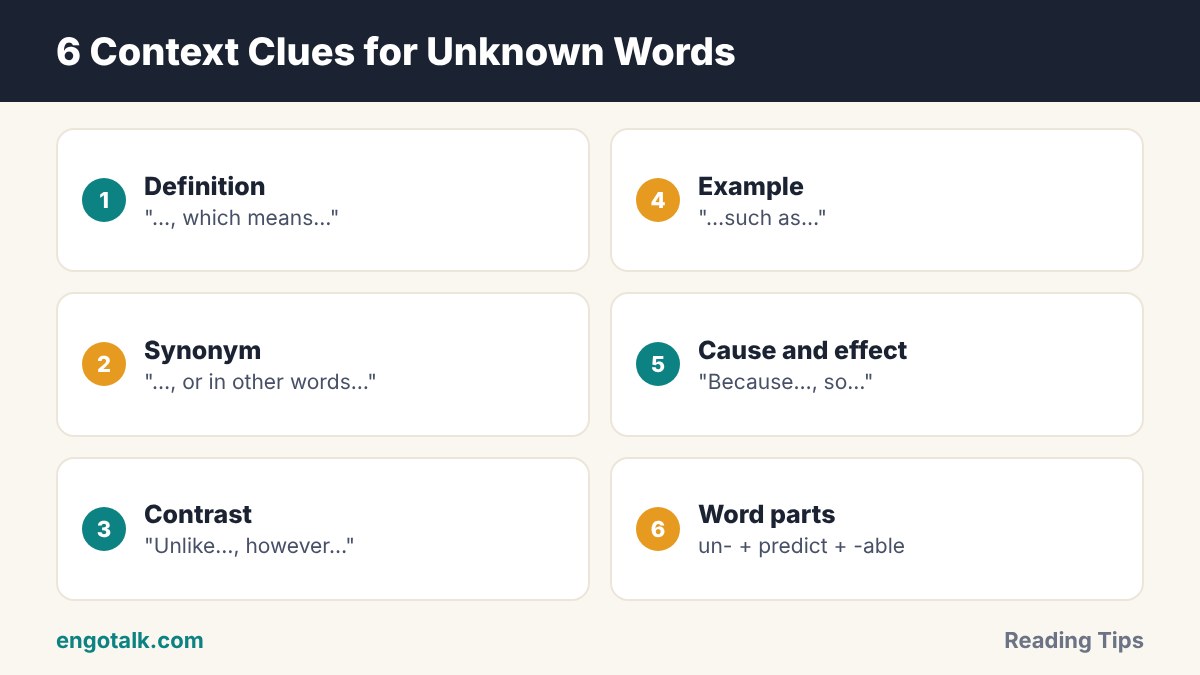
6 Types of Context Clues
1. Definition clues
The writer explains the word directly, often after is, means, refers to or between commas or dashes.
A nomad – a person who moves from place to place without a permanent home – often travels with animals.
2. Synonym clues
A word with a similar meaning appears nearby, often after or, also or in other words.
The instructions were ambiguous, or unclear, so nobody knew what to do.
3. Antonym or contrast clues
Words like but, however, unlike and although show the unknown word means the opposite of something.
Unlike his gregarious sister, who loves parties, Tom prefers to stay home alone.
If Tom prefers being alone, gregarious must mean sociable or outgoing.
4. Example clues
Phrases like such as, for example and including give examples of the word.
The shop sells citrus fruits such as oranges, lemons and limes.
5. Explanation or cause-and-effect clues
The rest of the sentence explains the result or reason, which reveals the meaning.
Because the bread was stale, it was too hard to eat.
6. General sense of the passage
Sometimes there is no single clue, but the topic and tone of the whole paragraph make the meaning clear. Ask yourself: is the word positive or negative? Is it a person, a thing, an action or a description?
Use Word Parts: Prefixes, Roots and Suffixes
Many English words are built from smaller parts. Knowing a few common ones helps you guess meanings even without context.
Prefixes: un-, in-, dis- (not), re- (again), pre- (before), mis- (wrongly), over- (too much)
Roots: port (carry), dict (say), vis/vid (see), aud (hear), bio (life)
Suffixes: -less (without), -ful (full of), -able (can be), -ist (person who)
For example, unpredictable = un (not) + predict (say before) + able (can be): something you cannot know in advance.
A 4-Step Method for Unknown Words
Ask: is this word important? If you understand the sentence without it, keep reading.
Identify the word type. Is it a noun, verb, adjective or adverb? Its position in the sentence tells you.
Look for clues in the same sentence, then the sentences before and after.
Make a guess and test it. Replace the word with your guess. Does the sentence still make sense?
When Should You Use a Dictionary?
Guessing is powerful, but it isn't perfect. Use a dictionary when:
the word appears many times and is clearly key to the text,
your guess doesn't make sense in other sentences,
you want to learn the pronunciation or use the word yourself.
A good habit is to guess while reading, underline the word, and check it in the dictionary after you finish. You'll be surprised how often your guess was right.
Practice Exercise
Guess the meaning of the word in bold. Answers are below.
After the long hike, we were famished and ate everything on the table.
The old bridge was precarious, so the city closed it before it could collapse.
She is usually very talkative, but today she was unusually reticent.
The museum displays artefacts such as ancient coins, tools and jewellery.
Answers: 1. extremely hungry (cause and effect) · 2. dangerous, likely to fall (explanation) · 3. quiet, not saying much (contrast) · 4. objects made by people in the past (examples)
How to Build This Skill
Read a little every day at a level that is slightly challenging. Our guide on the 20-minute reading method shows you how.
Keep a vocabulary notebook with the sentence where you found each word.
Read about topics you enjoy, so you keep going even when the text is difficult.
Learn more in our guide to building English vocabulary through reading, and test yourself with the free English Vocabulary Quiz.
Use Your New Words in Conversation
Words become part of your active vocabulary when you use them. On EngoTalk, you can join a live 1-on-1 video call and try new words in real conversations with learners and tutors. Start a practice call now.
Frequently Asked Questions
What are context clues in English reading?
They are hints in the surrounding text, such as definitions, synonyms, contrasts and examples, that help you understand an unfamiliar word.
Should I look up every new word when reading?
No. Look up only words that are important to the meaning or appear many times. Guess the others from context and keep reading.
How can I get better at guessing word meanings?
Read regularly, learn common prefixes, roots and suffixes, and check your guesses in a dictionary after reading.
Does guessing from context help in IELTS Reading?
Yes. You cannot use a dictionary in the exam, and many questions use synonyms or paraphrases, so this skill is essential.
Test yourself: 5-question quiz
Check what you remember from this article. It takes about one minute, and you earn XP for completing it.