
IELTS Speaking Part 2: How to Talk for 2 Minutes on Any Cue Card
In IELTS Speaking Part 2, the examiner gives you a cue card with a topic and three or four bullet points. You have one minute to prepare and then you must speak for up to two minutes without stopping. For many candidates, those two minutes feel very long. They run out of ideas after 40 seconds, repeat themselves, or freeze.
In this guide, you will learn how to use your one minute of preparation, a simple structure that easily fills two minutes, useful phrases to extend your answer, and a complete Band 7 sample answer.
How Part 2 Works
The examiner gives you a task card, paper and a pencil.
You have 1 minute to prepare and make notes.
You speak for 1 to 2 minutes. The examiner will stop you at 2 minutes.
The examiner may ask one or two short follow-up questions.
A typical cue card looks like this:
Describe a place you visited that you really enjoyed.
You should say:
– where it was
– when you went there
– what you did there
and explain why you enjoyed it.
Use Your 1 Minute of Preparation Well
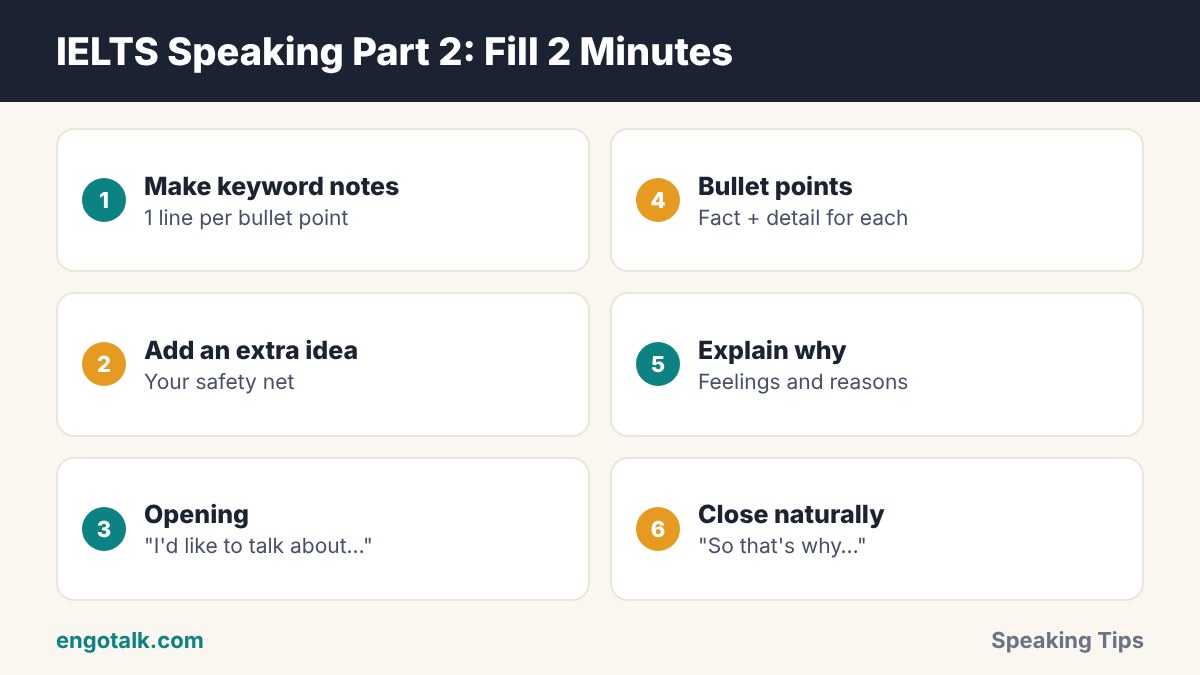
Don't write full sentences. Write keywords only, one line for each bullet point, plus one extra idea. Your notes might look like this:
Where: Lagos, Portugal, cliffs and beaches
When: last December, with cousins
What: sunrise walk, seafood, boat trip to caves
Why: first holiday after exams, relaxed, family
Extra: funny moment: lost phone in sand
The "extra" idea is your safety net. If you finish the bullet points too early, you still have something to talk about.
A Simple Structure That Fills 2 Minutes
Opening (10 seconds): Introduce the topic in one or two sentences. "I'd like to talk about a trip I took to…"
Bullet points 1–3 (60–70 seconds): About 20 seconds each. For each point, give a fact plus one detail or example.
The "explain" point (30–40 seconds): This is where you add feelings and reasons. It is usually the easiest part to extend.
Closing (10 seconds): Finish naturally. "So that's why it's one of my favourite memories."
5 Techniques to Extend Your Answer
1. Add the five senses
Describe what you saw, heard, smelled or tasted. "I can still remember the smell of grilled fish and the sound of the waves."
2. Tell a short story
A small event with a beginning and an end adds 20–30 seconds easily. "On the second day, something funny happened…"
3. Compare past and present
"When I was a child, the town was quiet, but now it's full of hotels."
4. Give your feelings and reasons
Use phrases like "What I loved most was…" and "The main reason was…".
5. Talk about the future
"I'm hoping to go back next year, and this time I'd like to…"
Useful Phrases for Part 2
Starting: "I'd like to talk about…", "The place I'm going to describe is…"
Adding details: "On top of that…", "What's more…", "Another thing I remember is…"
Giving reasons: "The main reason I enjoyed it was…", "This was partly because…"
Buying time naturally: "Let me think…", "How can I put this…"
Finishing: "Overall…", "So that's why…", "All in all…"
Band 7 Sample Answer
I'd like to talk about a trip I took to Lagos, a small coastal town in the south of Portugal that's famous for its golden cliffs and beautiful beaches.
I went there last December with three of my cousins, just after we'd finished our university exams, so we were all in a really good mood. We stayed in a small guesthouse about five minutes from the sea.
As for what we did, we tried to make the most of every day. We got up early to watch the sunrise, which was absolutely stunning, and in the afternoons we took a small boat to explore the sea caves along the coast. In the evenings, we ate fresh seafood at little restaurants by the harbour. I can still remember the smell of grilled fish and the sound of the waves. On the second day, something funny happened: my cousin dropped his phone in the sand and we spent almost an hour looking for it!
The main reason I enjoyed this trip so much was that it was the first time in months that I felt completely relaxed. Before that, I'd been studying almost every day, so it felt like a well-deserved break. It also brought me closer to my cousins, because we rarely spend time together now that we live in different cities.
So, all in all, it's one of my favourite memories, and I'm hoping to go back next year.
Read aloud at a natural speed, this answer lasts about two minutes. Notice the past tenses, the story, the sensory details and the clear reasons.
Common Mistakes
Stopping after one minute. Always keep talking until the examiner stops you.
Memorised answers. Examiners recognise them, and they can lower your score.
Reading your notes. Glance at keywords, then look up and speak.
Only answering the bullet points briefly. Each point needs a fact plus a detail.
Using only present tense. Most cue cards need past tenses. Check which time the question is about.
How to Practise
Pick a cue card topic, set a 1-minute timer for notes and a 2-minute timer for speaking.
Record yourself and listen back. Did you reach two minutes? Which words did you repeat?
Practise the same topic again the next day and add one new technique.
Our conversation topics pages include a built-in one-minute speaking timer, perfect for this kind of practice. For more exam strategies, read IELTS Speaking tips for Band 7+.
Practise IELTS Speaking with a Real Partner
Speaking is the one IELTS skill you can't fully practise alone. On EngoTalk, you can join a live 1-on-1 video call, give your partner a cue card and take turns speaking for two minutes. Start a practice call now.
Frequently Asked Questions
What happens if I can't speak for 2 minutes in Part 2?
You won't automatically fail, but speaking for less time gives the examiner less evidence of your fluency and vocabulary, which usually lowers your score.
Should I memorise answers for IELTS Speaking Part 2?
No. Prepare ideas and vocabulary for common topics, but speak naturally. Memorised answers sound unnatural and examiners are trained to notice them.
Can I make up a story in Part 2?
Yes. The examiner is assessing your English, not the truth of your story. If you can't think of a real example, invent a believable one.
What should I write in my 1-minute notes?
Write short keywords for each bullet point and one extra idea or story you can use if you finish early.
Test yourself: 5-question quiz
Check what you remember from this article. It takes about one minute, and you earn XP for completing it.