
How to Understand English Phone Calls: Tips and Useful Phrases
Many English learners feel confident in face-to-face conversations but panic when the phone rings. On a call, you cannot see the speaker's face, lips or gestures, the sound quality may be poor, and there is pressure to reply quickly. Even advanced learners often say phone calls are the hardest part of using English at work.
The good news is that phone calls follow predictable patterns. In this guide, you will learn why calls are difficult, practical techniques to understand more, and the exact phrases to ask someone to repeat, slow down or spell something, without feeling embarrassed.
Why Phone Calls Are Harder Than Face-to-Face Conversations
No visual clues. In person, we understand a lot from facial expressions and lip movements. On the phone, you only have sound.
Lower sound quality. Phone audio cuts out high frequencies, which makes sounds like /s/, /f/ and /th/ harder to hear.
Fast, connected speech. Native speakers link words together: "What are you going to do?" can sound like "Whaddaya gonna do?"
Names, numbers and spellings. These carry key information and are easy to mishear.
Pressure. Silence feels awkward on the phone, so learners often pretend to understand.
Before the Call: Prepare
If you know a call is coming, a few minutes of preparation will dramatically increase how much you understand.
Predict the topic. Write down five words or questions you expect to hear.
Prepare your key sentences, such as your reason for calling or the information you need.
Have a pen and paper ready for names, numbers and dates.
Find a quiet place and use headphones if possible. Better audio means better understanding.
During the Call: Listen for Key Words
You do not need to understand every word. Focus on the content words that carry meaning: nouns, main verbs, numbers, names and negative words like not and can't. Small words such as to, of and the are usually spoken quickly and quietly, so don't worry if you miss them.
For example, if you hear "…delivery… Thursday… after three…", you already know the main message: the delivery will arrive on Thursday after 3 pm. Then you can confirm it.
Phrases to Ask Someone to Repeat or Slow Down
Asking for repetition is normal and polite. Native speakers do it all the time on the phone.
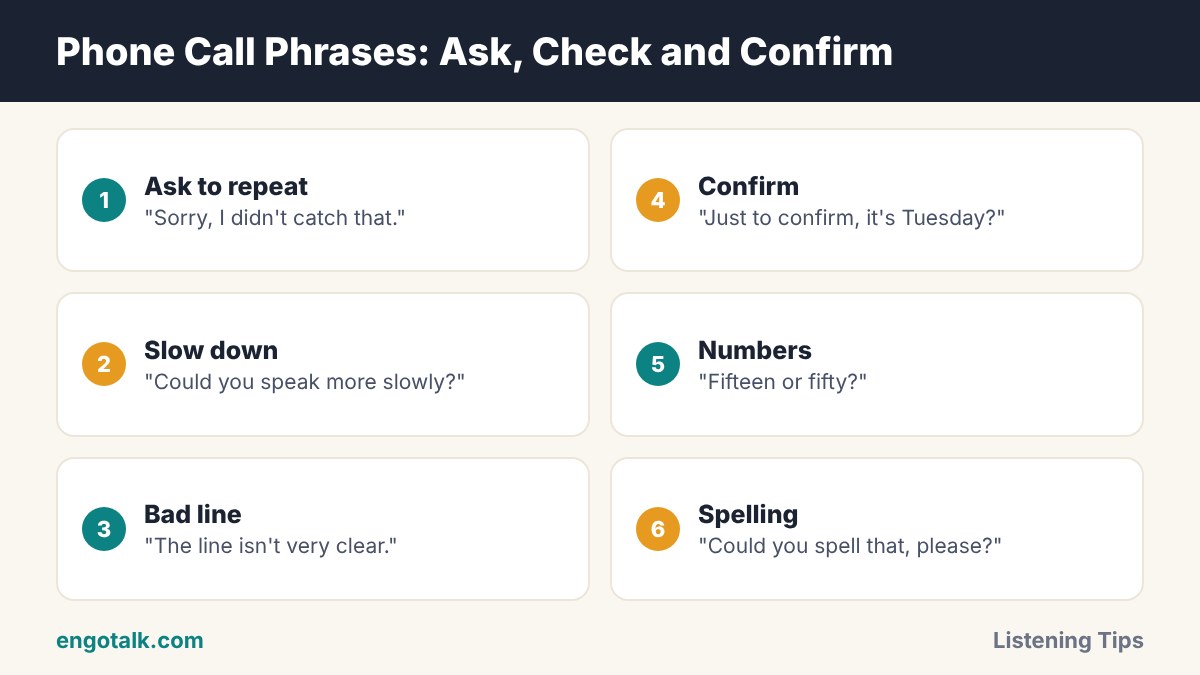
"Sorry, could you say that again, please?"
"I'm sorry, I didn't catch that."
"Could you speak a little more slowly, please?"
"Sorry, the line isn't very clear. Could you repeat the last part?"
"Could you speak up a little? I can't hear you very well."
Phrases to Check and Confirm Information
Repeating information back is the best way to avoid misunderstandings, especially with times, dates and numbers.
"Just to confirm, the meeting is on Tuesday at 10 am, is that right?"
"So, if I understand correctly, you need the report by Friday?"
"Let me read that back to you: 0-7-7-0, 9-0-0, 1-2-3."
"Did you say fifteen or fifty?"
Tip: Numbers like fifteen/fifty, thirteen/thirty and nineteen/ninety are often confused. Ask "One-five or five-zero?" to be sure.
Phrases to Ask for Spelling
"Could you spell that for me, please?"
"Is that B for Bravo or P for Papa?"
"How do you spell your surname?"
Learning the phonetic alphabet (Alpha, Bravo, Charlie, Delta…) helps both when you spell your own name and when you check someone else's.
Example Phone Call
Receptionist: Good morning, Greenfield Dental, Amy speaking. How can I help?
Caller: Hi, I'd like to book an appointment for a check-up, please.
Receptionist: Sure. We've got something on Thursday at quarter past four.
Caller: Sorry, I didn't catch the time. Could you repeat that?
Receptionist: Of course. Four fifteen on Thursday.
Caller: Great. Just to confirm, that's Thursday the 12th at 4:15?
Receptionist: That's right. Can I take your name, please?
Caller: It's Rahman, R-A-H-M-A-N.
The caller didn't understand everything the first time, but by asking and confirming, nothing went wrong. That is exactly the skill you need.
How to Practise Understanding Phone English
Listen to audio without video. Podcasts and radio train your ears to understand without visual clues. See our list of the best free English podcasts.
Practise with fast speech. Our guide on how to understand fast English speakers explains connected speech in detail.
Make real calls. Call a hotel, a shop or a customer service line in English to ask a simple question.
Practise audio-only calls with a partner. Turn off your camera so you rely only on listening.
Write down numbers you hear. Ask a friend to read phone numbers and prices to you quickly.
Practise Real Conversations on EngoTalk
The fastest way to lose your fear of phone calls is to have more real conversations. On EngoTalk, you can join a 1-on-1 call with a learner or tutor in seconds. Try turning your camera off for the first few minutes to practise listening without visual help. Start a practice call now.
Frequently Asked Questions
Why is it so hard to understand English on the phone?
Because you cannot see the speaker, phone audio is lower quality, and people often speak fast with connected speech. Preparation and checking phrases help a lot.
Is it rude to ask someone to repeat on the phone?
No. It is completely normal. Saying "Sorry, I didn't catch that" is polite and much better than misunderstanding important information.
How can I improve my phone English quickly?
Prepare before calls, listen for key words, confirm information by repeating it, and practise audio-only conversations regularly.
How do I spell my name clearly on the phone?
Spell slowly letter by letter and use the phonetic alphabet for letters that sound similar, for example "B for Bravo" or "M for Mike".
Test yourself: 5-question quiz
Check what you remember from this article. It takes about one minute, and you earn XP for completing it.