
How to Describe a Picture in English: Useful Phrases and Examples

"Describe the picture." It sounds simple, but it is one of the most common speaking tasks in English exams, job interviews for teaching roles, classroom activities and language apps. Many learners look at the image, say "There is a man and a woman," and then don't know what to say next.
In this guide, you will learn a clear step-by-step structure, the prepositions and phrases you need to say where things are, how to describe people and actions, how to speculate about what is happening, and a full sample description you can model your answers on.
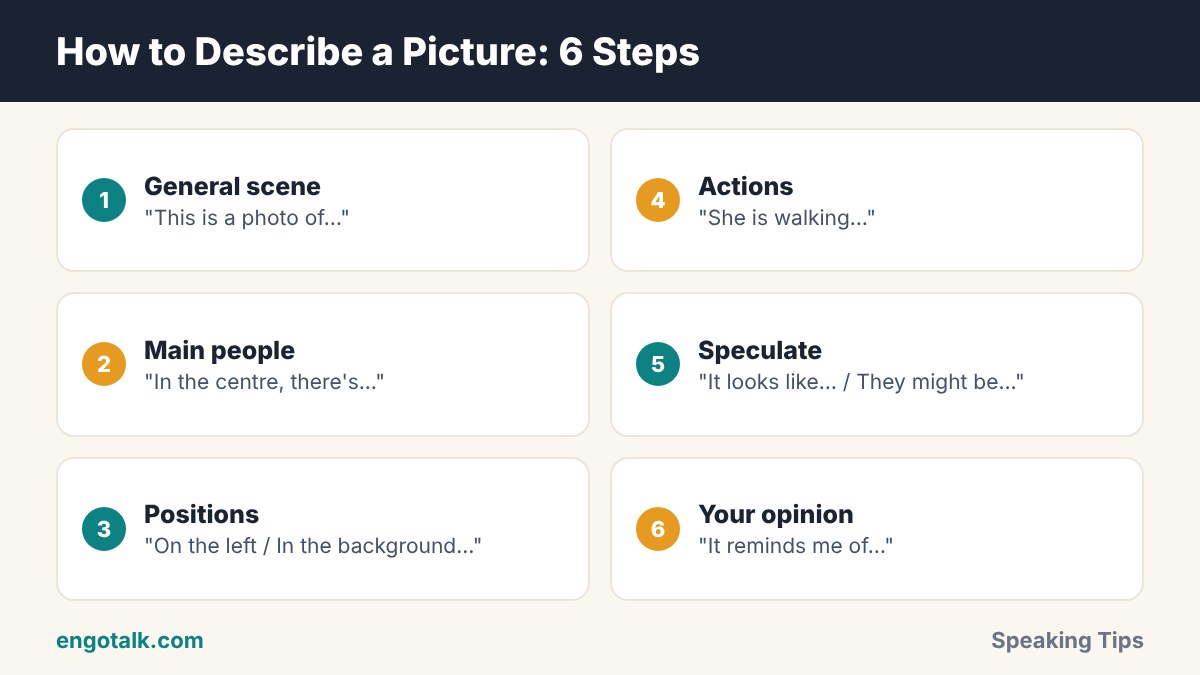
A 6-Step Structure
Follow this order and you will always have something to say, moving from the big picture to small details and finally to your own ideas.
Say what kind of picture it is and the general scene. "This is a photo of a busy street market."
Describe the main people or objects. "In the centre, there's a woman selling vegetables."
Say where things are. "On the left, there are some fruit stalls."
Describe actions. "A man is paying for some apples."
Speculate. "It looks like it's early in the morning."
Give your opinion or a personal connection. "It reminds me of the market near my home."
Phrases for Saying Where Things Are
Parts of the picture: in the foreground, in the background, in the middle / centre, on the left, on the right, at the top, at the bottom, in the top-left corner
Positions: next to, behind, in front of, between, opposite, above, below, near, surrounded by
Example: "In the foreground, a young boy is sitting next to his dog. In the background, you can see some mountains."
Tip: We say in the foreground/background/centre but on the left/right and at the top/bottom.
Describing People
Age: a child, a teenager, a young woman, a middle-aged man, an elderly couple, in his twenties
Appearance: She has long dark hair. He's tall and slim. He's wearing glasses.
Clothes: She's wearing a red jacket and jeans. They're dressed in uniforms.
Expressions: smiling, laughing, frowning, looking worried, looking relaxed
Describing Actions: Use the Present Continuous
When you describe what people are doing in a picture, use the present continuous (am/is/are + -ing), because the action is happening in the moment shown.
"Two people are walking along the beach."
"The waiter is carrying a tray of drinks."
"A group of students are sitting around a table and discussing something."
Use the present simple for things that are always true in the picture: "The house has a red roof."
Speculating: What Might Be Happening?
Good descriptions go beyond what you can see. Speculating shows a higher level of English and gives you much more to talk about.
"It looks like they're on holiday."
"They might be celebrating a birthday."
"He must be tired after a long day." (strong certainty)
"She can't be very happy." (strong certainty it isn't true)
"I'd guess the photo was taken in winter, because…"
"Judging by their clothes, it's probably a formal event."
Sample Description
Picture: A family having a picnic in a park.
This is a photo of a family having a picnic in a park on what looks like a sunny summer day. In the foreground, there are four people sitting on a large blue blanket: a mother, a father and two young children. The mother is pouring some juice, while the father is laughing at something the little girl is saying.
On the right, there's a picnic basket full of sandwiches and fruit, and next to it, a small dog is sleeping in the shade. In the background, you can see some tall trees and a few other people walking along a path.
Everyone looks relaxed and happy. Judging by their clothes, it must be quite warm. I'd guess it's the weekend, because the park seems quite busy. Personally, I love pictures like this because they remind me of family trips I took when I was a child.
Notice how the description moves from general to specific, uses position phrases, present continuous verbs and speculation, and ends with a personal comment.
Common Mistakes
"In the picture I can see there is…" – Choose one: "In the picture, there is…" or "In the picture, I can see…"
"In the left" ❌ → "On the left" ✅
"The man wears a hat" (for this moment) → "The man is wearing a hat."
Listing objects without connecting them. Use linking words like while, next to it and behind them.
Stopping too early. If you run out of ideas, speculate or give a personal connection.
How to Practise
Use any photo from a news website, social media or your own phone.
Set a timer for one minute and describe it out loud using the 6-step structure.
Record yourself and count how many position phrases and speculation phrases you used.
Play a game with a partner: describe a picture while they try to draw it without seeing it.
For more ideas to keep a conversation going, see our guide on practising English conversation without a partner, and improve your accuracy with the free English Grammar Quiz.
Practise Describing Pictures with a Partner
Describing pictures is a fantastic activity for live practice. On EngoTalk, you can join a 1-on-1 video call, share a photo and take turns describing it. Your partner can ask follow-up questions to help you add more detail. Start a practice call now.
Frequently Asked Questions
Which tense should I use to describe a picture?
Use the present continuous for actions happening in the picture ("She is reading") and the present simple for general facts ("The room has two windows").
How do I start describing a picture in English?
Start with the general scene: "This is a photo of…" or "The picture shows…". Then move to the main people, positions, actions and your ideas.
Is it "in the left" or "on the left"?
"On the left" and "on the right" are correct. Use "in" for the foreground, background and centre.
How can I describe a picture for longer?
Add speculation ("They might be…"), describe feelings and expressions, and finish with a personal opinion or memory.
Test yourself: 5-question quiz
Check what you remember from this article. It takes about one minute, and you earn XP for completing it.